

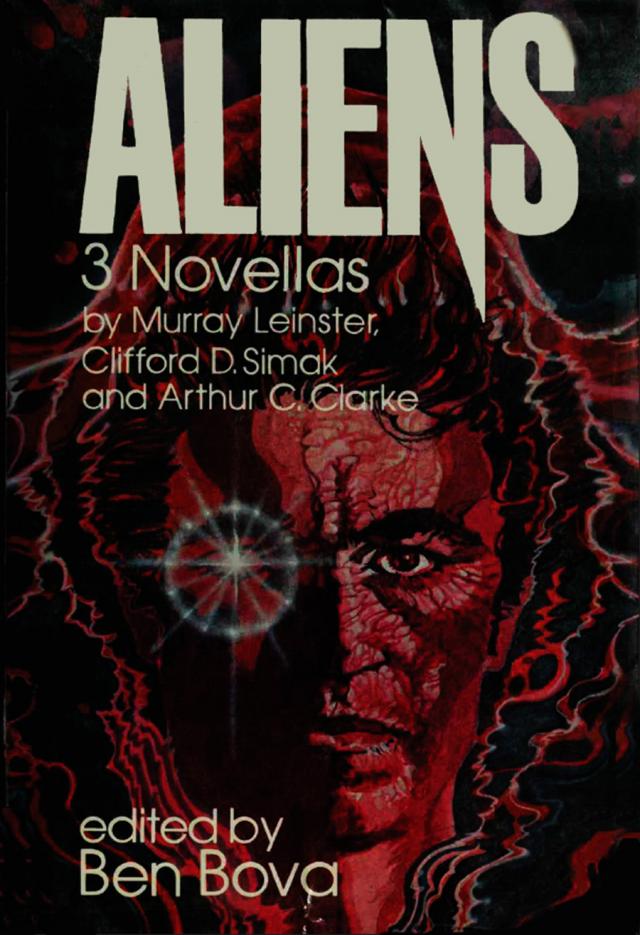
Aliens 3 novellas, p.1
Aliens: 3 Novellas, page 1


Jerry eBooks
No copyright 2017 by Jerry eBooks
No rights reserved. All parts of this book may be reproduced in any form and by any means for any purpose without any prior written consent of anyone.
ALIENS
edited by
Ben Bova
Ben Bova, the distinguished editor of Analog magazine, was in despair over a problem that has, for decades, nagged science fiction editors and impoverished science fiction readers: how to anthologize novellas. Too many wonderful stories have been penalized for their length and gone unread, but now Ben Bova and St. Martin’s Press present a solution. Aliens is a collection of three novellas by three of the SF greats: Murray Leinster, Clifford D. Simak and Arthur C. Clarke. Exiles, also available from St. Martin’s, puts together three novellas by Poul Anderson, Eric Frank Russell, and Isaac Asimov. A two-volume feast! These are truly the classic science fiction novellas of all time, penned by the masters. Included in this volume:
FIRST CONTACT by Murray Leinster . . . deep in the Crab Nebula an expedition from Earth encounters an alien craft—but neither human nor alien can let the other survive . . .
THE BIG FRONT YARD by Clifford D. Simak . . . An old house in a small town becomes a gateway to another world in Simak’s Hugo-winning novella.
A MEETING WITH MEDUSA by Arthur C. Clarke . . . An airship disaster left him mutilated but specially adapted to alien worlds. Now he was drifting in the winds of Jupiter—and he was the first man to face alien beings. But were they intelligent . . . and were they hostile?
The range and diversity of these short novels, combined with the genius and narrative skills for which their authors are justly famed, will provide every lover of science fiction with a memorable read designed to make you cry for more!
BEN BOVA is a prolific writer of both science fact and fiction. A graduate of Temple University, he has been a motion picture script writer and a technical editor for Project VANGUARD. A four-time Hugo Award winner for editing Analog, his most recent novel was Millennium.
Aliens
This compilation and introduction
Copyright© 1977 by Ben Bova
All rights reserved. For information, write:
St. Martin’s Press, Inc.,
175 Fifth Ave., New York, N.Y. 10010.
Manufactured in the United States of America
Library of Congress Cataloging in Publication Data
Main entry under title:
Aliens: 3 novellas.
CONTENTS: Leinster, M. [i.e. W.F. Jenkins].
First contact.—Simak, C. The big front yard.—
Clarke, A.C. A meeting with Medusa.
1. Science fiction, American. I. Jenkins,
William Fitzgerald, 1896- First contact. 1978.
II. Simak, Clifford D.'f 1904- The big front
yard. 1978. III. Clarke, Arthur Charles,
1917- A meeting with Medusa. 1978. IV. Bova,
Benjamin.
PZ1.A4133 [PS648.S3] 813'.0876 78-3958
ISBN 0-312-01859-2
Aliens
3 Novellas
(book cover)
About the Book
About Ben Bova
Title Page
Copyright
Acknowledgments
Introduction
FIRST CONTACT - Murray Leinster
THE BIG FRONT YARD - Clifford D. Simak
A MEETING WITH MEDUSA - Arthur C. Clarke
(back cover)
ACKNOWLEDGEMENTS
FIRST CONTACT by Murray Leinster copyright © 1945 by Street & Smith Publications Inc. Reprinted by permission of A.M. Heath & Company Limited.
THE BIG FRONT YARD by Clifford Simak copyright © 1958 Street & Smith Publications Inc. Reprinted by permission of the author.
A MEETING WITH MEDUSA by Arthur C. Clarke copyright © 1961 by Playboy Enterprises Inc. Reprinted by permission of the author and the author’s agents, Scott Meredith Literary Agency Inc., 845 Third Avenue, New York, NY10022.
INTRODUCTION
By Ben Bova
In the Army they teach you that you don’t salute the man, you salute the uniform. For me to be introducing Clifford D. Simak, Murray Leinster, and Arthur C. Clarke . . . well, it makes me feel like a shavetail lieutenant sauntering past a trio of grizzled, battle-wise veterans.
It has been my pleasure to meet each of these gentlemen, and to work with each of them. But before I bog down in personal reminiscences, there is some official business to get out of the way.
This book is the first in a series that will feature the most distinguished writers in the science fiction field, and their most distinguished stories. More than that: Futura Publications’ and St. Martin’s Press’s THREE BY series represents a solution to a problem that has, for decades, nagged science fiction editors and impoverished science fiction readers.
The problem is simply this: how can we anthologize novellas?
Unless you are intimately familiar with the publishing business and its peculiar institutions, the question may mean nothing to you. So let me explain.
Science fiction is probably the most difficult form of literature to write. Isaac Asimov, who has written just about everything, assures me that this is true, so it must be so. In a science fiction story, the author must not only accomplish all the characterizations, mood, style, and plot of any type of story; he (or she) must in addition describe to the reader a whole new world, one that has never existed before, a world that is the invention of the author and has never been seen by anyone else.
Thus, when an author writes a contemporary story and says that the hero took a bus from home to office, the reader can immediately visualize the situation. Even in an historical novel, when the hero rides his foaming stallion from manor house to castle wall, the reader can still picture the scene quite clearly.
But how does the author make the reader see what’s going on when the hero teleports from a lunar colony to an interstellar ship cruising beyond 61 Cygni at nearly the speed of light? The author must show the reader, in some little detail, every aspect of the scene—because none of it is familiar, none of it based on the common pool of experience that the author and the reader share.
This need to build every detail of a story carefully, painstakingly, and yet entertainingly—so that the reader is not put off by dull lectures on engineering or astrophysics—places an additional burden on the writer of science fiction. A burden that does not exist for any other kind of writer.
It also tends to make science fiction stories longer and more elaborately detailed than most other types of fiction.
As a writer, I have often found it most difficult to produce a science fiction short story that is more meaningful than a sketch. As an editor, I see every day how tough it is for other writers to turn out strong short stories in the science fiction genre.
The best science fiction stories are often of lengths far greater than that of a short story. Many of the very best science fiction stories ever written are of a length that book publishers find almost impossible to deal with—from 20,000 to 40,000 words long.
They are usually called novellas, meaning short novels. Sometimes they are called novelettes, which is a term that generally connotes an extended short story. The two forms overlap in word-length, but not in style or treatment. The novella is a minor novel; its only difference from a full-blown novel is that it is less than the 60, 000-word length that publishers usually require as a minimum for an individual book. The novelette is a long short story, in form, or sometimes a pair of interlocked short stories.
A story of twenty or thirty thousand words presents a problem for a book publisher. The story is too short to be published by itself; it is not “book length”. Yet it is often too long for an anthology; it would take up nearly half the anthology’s pages and force the anthologist to drop several short stories to make room for one novella. Since anthologies are frequently sold on the strength of the contributors’ names, it has become common wisdom to give the readers as many stories—hence as many authors—as possible.
Thus the novella is frequently homeless, relegated to publication in a magazine or in the occasional collection of stories by a single author.
The THREE BY series is intended to correct this unhappy situation. Each book of this series will include three novellas (or, in some cases, novelettes) that are acknowledged classics in the science fiction field, by authors who are acknowledged masters. Yet because of the mechanical problems discussed above, the novellas and novelettes in the THREE BY series have rarely been published in anthologies before.
Thanks to Futura Publications’ dedication to presenting excellent science fiction, and to solving “the novella problem”, you can look forward to reading classic science fiction stories that have been virtually unobtainable for years.
And now, about the authors.
There is no point in introducing their stories, because the stories will speak for themselves far better than any introductory remarks can.
Instead of speaking about the stories, then, let me give you a look at a few key incidents that, I think, illuminate the mind and personality of each of these fine writers.
Gentleman is the word that comes easiest to mind when I think of Clifford Simak. A gentle man. At the Nebula Awards banquet of the Science Fiction Writers of America in New York, 30 April 1977, Cliff Simak was the featured speaker. Most of those present knew that he was to receive a special
Grand Master Nebula Award, an honor that had previously been bestowed only up
During his speech he was as nervous as a high school valedictorian. He is not a public man. After half a century as a newspaperman, he is still basically shy. He confessed that he had nothing very exciting to say, and then he spoke about his work in the science fiction field—the problems he faced, the times of disappointment and trial, the frustrations. He mentioned also the rewards of his work: not awards and honors, but friendships that have lasted through the decades, and the quiet pride of accomplishment.
By the time he finished his ten-minute speech, there was hardly a dry eye among that rather tough-minded audience of science fiction professionals.
I would like to think that if a space warp does open up, somewhere on Earth, and intelligent alien creatures step through it to inspect our planet and weigh the worth of its citizenry, the warp will be Cliff Simak’s front yard—however large or small that may be. If it is, then I know that our race will be well represented.
I met Murray Leinster only once.
For years I had read his stories, and had known that Will F. Jenkins (his real name) was one of the last and best independent inventors in the United States. His inquisitive mind ranged over many different areas, but in his last years most of his work centered on aspects of photography. He invented, for example, a front-projection system for use in motion picture work that was the forerunner of the uncannily “real” projections used in the Clarke/Kubrick masterwork, “2001: A Space Odyssey”.
Mr. Jenkins telephoned the Analog office shortly after I had become editor of the magazine, and told me that he would be in New York the following week. I immediately invited him to lunch.
Once we met it was apparent that he was not in robust health. He had just recovered from a long siege of illness. The death of his wife had hurt him deeply. Yet he was alert, inquisitive, and full of ideas. He showed me a piece of film he was working on: it was both a positive and a negative, depending on the angle of the light falling upon it. At lunch we talked mainly about John Campbell, whom we both revered, and about Murray Leinster’s stories, which went back as far as 1912, predating the earliest science fiction magazines.
After lunch was finished and we were bidding farewell to each other, he remarked with a grin, “You know, we’ve been talking to each other for several hours now, and neither one of us has come up with a single brilliant idea!”
I don’t think he was entirely joking. He expected brilliant ideas to arise every few hours, either from his own mind or from those around him. Certainly, with John Campbell, he must have met his match in creativity.
To this day, whenever I lean back in my desk chair and admire the awards that Analog has gathered, I can still hear Murray Leinster whispering to me, “Remember Caesar, thou art mortal!”
What can I say about Arthur Clarke that hasn’t already been said? Plenty.
In 1956, when Arthur Clarke visited the Martin Aircraft Co., where I was a junior technical editor on the Vanguard satellite launching project, I was given the happy task of ushering Arthur through the project, making certain that he got all the information he needed for the book he was doing on “man’s first artificial satellite”. Before he left the premises, I had the gall to push a three-hundred-page manuscript of mine on to him. The inevitable first novel. And he had the kindness to take it all the way back to his home in Ceylon, read it, and mail it back to me with a long letter of stem advice and gentle encouragement.
I remember driving Arthur through a New Jersey fog one dismal night, years later crawling along at five miles per hour, desperately trying to see past the car’s hood ornament while he blithely chatted about real fogs in London! We have met many times over the past twenty-some years but my favorite meeting came in 1976 in Washington D.C. That awful first manuscript I had palmed off on him twenty years earlier had finally grown into a published book, titled Millennium. I gave Arthur one of the first copies off the press and thanked him for reading the earliest version of the novel.
“I read what?” he asked, incredulous. “I never read other people’s manuscripts. Never!”
And with that, he pulled a printed sheet of paper out of his briefcase, scribbled my name at its top, and presented it to me. It was a form letter, explaining that he simply doesn’t have the time to read and comment on other people’s manuscripts.
I treasure that form letter. And the longer, more personal letter he sent to me in 1956.
Now you know something about how and why this book came into being, and about the writers who have contributed to it. It is time to mention two very important persons whose names do not appear elsewhere,
I want to express my gratitude to Anthony J. V. Cheetham, of Futura Publications Ltd, who originated the idea for the THREE BY series, and to Victoria Schochet, my Associate Editor at Analog magazine, who did most of the real work connected with this book. Without them, this book could never have come into being.
Ben Bova
Manhattan
May 1977
FIRST CONTACT
by Murray Leinster
An expedition from Earth had gone to investigate the Crab Nebula. And—an expedition from Somewhere was already there! Now what is a spaceship skipper to do wider such circumstances? Lead the possibly-deadly aliens home? Try to destroy them? What can he do?
I
Tommy Dort went into the captain’s room with his last pair of stereophotos and said:
“I’m through, sir. These are the last two pictures I can take.”
He handed over the photographs and looked with professional interest at the visiplates which showed all space outside the ship. Subdued, deep-red lighting indicated the controls and such instruments as the quartermaster on duty needed for navigation of the spaceship Llanvabon. There was a deeply cushioned control chair. There was the little gadget of oddly angled mirrors—remote descendant of the back—view mirrors of twentieth-century motorists—which allowed a view of all the visiplates without turning the head. And there were the huge plates which were so much more satisfactory for a direct view of space.
The Llanvabon was a long way from home. The plates, which showed every star of visual magnitude and could be stepped up to any desired magnification, portrayed stars of every imaginable degree of brilliance, in the startlingly different colors they show outside of atmosphere. But every one was unfamiliar. Only two constellations could be recognized as seen from Earth, and they were shrunken and distorted. The Milky Way seemed vaguely out of place. But even such oddities were minor compared to a sight in the forward plates.
There was a vast, vast mistiness ahead. A luminous mist. It seemed motionless. It took a long time for any appreciable nearing to appear in the vision plates, though the spaceship’s velocity indicator showed an incredible speed. The mist was the Crab Nebula, six light-years long, three and a half light-years thick, with outward-reaching members that in the telescopes of Earth gave it some resemblance to the creature for which it was named. It was a cloud of gas, infinitely tenuous, reaching half again as far as from Sol to its nearest neighbor-sun. Deep within it burned two stars; a double star; one component the familiar yellow of the sun of Earth, the other an unholy white.
Tommy Dort said meditatively:
“We’re heading into a deep, sir?”
The skipper studied the last two plates of Tommy’s taking, and put them aside. He went back to his uneasy contemplation of the vision plates ahead. The Llanvabon was decelerating at full force. She was a bare half light-year from the nebula. Tommy’s work was guiding the ship’s course, now, but the work was done. During all the stay of the exploring ship in the nebula, Tommy Dort would loaf. But he’d more than paid his way so far.
He had just completed a quite unique first—a complete photographic record of the movement of a nebula during a period of four thousand years, taken by one individual with the same apparatus and with control exposures to detect and record any systematic errors. It was an achievement in itself worth the journey from Earth. But in addition, he had also recorded four thousand years of the history of a double star, and four thousand years of the history of a star in the act of degenerating into a white dwarf.






