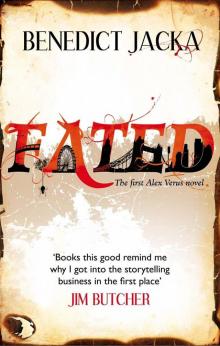
An inheritance of magic, p.1
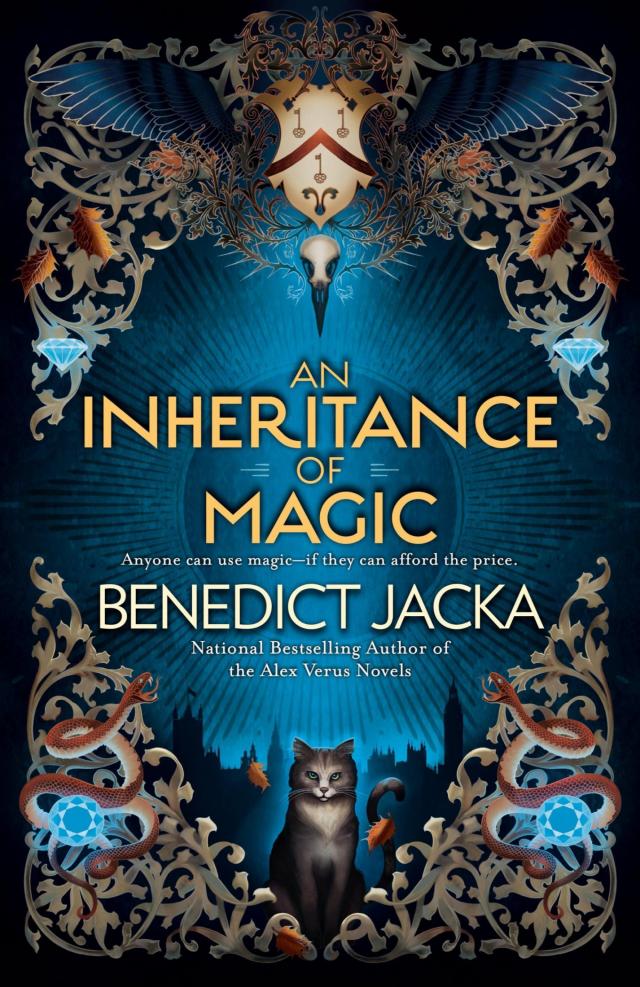
An Inheritance of Magic, page 1


Praise for
An Inheritance of Magic
“Benedict Jacka gives us a flawed protagonist but ensures we are always on his side. Stephen Oakwood has many strikes against him: absent father and mother, financial woes, dead-end jobs. But he perseveres in the face of danger and death, and he loves his cat. It’s more than enough. Benedict Jacka is one of my must-reads.”
—#1 New York Times bestselling author Charlaine Harris
“Jacka has drawn a potent new world of magic controlled by a privileged few, and Stephen Oakwood is the sigl-wielding rebel we didn’t know we needed.”
—New York Times bestselling author Chloe Neill
Praise for
the Alex Verus series
“Harry Dresden would like Alex Verus tremendously—and be a little nervous around him. . . . A gorgeously realized world with a uniquely powerful, vulnerable protagonist.”
—Jim Butcher, #1 New York Times bestselling author of the Dresden Files
“Benedict Jacka writes a deft thrill ride of an urban fantasy—a stay-up-all-night read.”
—Patricia Briggs, #1 New York Times bestselling author of the Mercy Thompson series
“A superior urban fantasy series that’s worth any reader’s time.”
—Publishers Weekly
“Benedict Jacka joins the top ranks of urban fantasy writers. . . . Few writers have mastered the ability to bring so many different types of characters to life so vividly.”
—SF Site
BOOKS BY BENEDICT JACKA
An Inheritance of Magic
The Alex Verus Series
Fated
Cursed
Taken
Chosen
Hidden
Veiled
Burned
Bound
Marked
Fallen
Forged
Risen
ACE
Published by Berkley
An imprint of Penguin Random House LLC
penguinrandomhouse.com
Copyright © 2023 by Benedict Jacka
Penguin Random House supports copyright. Copyright fuels creativity, encourages diverse voices, promotes free speech, and creates a vibrant culture. Thank you for buying an authorized edition of this book and for complying with copyright laws by not reproducing, scanning, or distributing any part of it in any form without permission. You are supporting writers and allowing Penguin Random House to continue to publish books for every reader.
ACE is a registered trademark and the A colophon is a trademark of Penguin Random House LLC.
Library of Congress Cataloging-in-Publication Data
Names: Jacka, Benedict, author.
Title: An inheritance of magic / Benedict Jacka.
Description: First edition. | New York : Ace, 2023.
Identifiers: LCCN 2023006156 (print) | LCCN 2023006157 (ebook) | ISBN 9780593549841 (trade paperback) | ISBN 9780593549858 (ebook)
Subjects: LCSH: Magic--Fiction. | LCGFT: Fantasy fiction. | Paranormal fiction. | Novels.
Classification: LCC PR6110.A22 I54 2023 (print) | LCC PR6110.A22 (ebook) | DDC 823/.92—dc23/eng/20230216
LC record available at https://lccn.loc.gov/2023006156
LC ebook record available at https://lccn.loc.gov/2023006157
First Edition: October 2023
Cover illustration © Marisa Ware
Cover design by Judith Lagerman
Book design by Katy Riegel, Adpted for ebook by Kelly Brennan
This is a work of fiction. Names, characters, places, and incidents either are the product of the author’s imagination or are used fictitiously, and any resemblance to actual persons, living or dead, business establishments, events, or locales is entirely coincidental.
pid_prh_6.1_145105281_c0_r0
CONTENTS
Cover
Praise For Benedict Jacka
Books by Benedict Jacka
Title Page
Copyright
Dedication
Author’s Note
Chapter 1
Chapter 2
Chapter 3
Chapter 4
Chapter 5
Chapter 6
Chapter 7
Chapter 8
Chapter 9
Chapter 10
Chapter 11
Chapter 12
Chapter 13
Chapter 14
Chapter 15
Chapter 16
Chapter 17
Chapter 18
Chapter 19
Chapter 20
Chapter 21
Glossary
About the Author
_145105281_
In memory of Cyril Keith Jacka
1927–2022
AUTHOR’S NOTE
Welcome to the beginning of my new series! I hope to keep working on it for the next ten years or so.
For those who have already read my Alex Verus novels, be aware that this world is a separate one, and the magic works in a very different way. This first book is designed to work as an introduction to the setting, but for those interested in knowing more, a glossary of terms is included at the back of the book.
I hope you enjoy the story!
—Benedict Jacka, February 2023
CHAPTER 1
There was a strange car at the end of my road.
I’d only leant out of my window for a quick look around, but as I saw the car I paused. All around me were the sounds and smells of the London morning: fresh air that still carried the chill of the fading winter, the dampness of last night’s rain, birdsong from the rooftops and the trees. Pale grey clouds covered the sky, promising more showers to come. Everything was normal . . . except for the car.
Spring had come early this year, and the cherry tree outside my window had been in bloom long enough for its flowers to turn from white to pink and begin to fall. The car was just visible through the petals, parked at the end of Foxden Road at an angle that gave it a clear line of sight to my front door. It was sleek and ominous, shiny black with tinted windows, and it looked like a minivan. Nobody on our street owns a minivan, especially not one with tinted windows.
A loud “Mraooow” came from my feet.
I looked down to see a grey-and-black tabby cat watching me with yellow-green eyes. “Oh, fine, Hobbes,” I told him, and shifted. Hobbes sprang up onto the sill, rubbed his head against my shoulder until I gave him a scratch, then jumped down onto the ledge that ran along the front of the building. I gave the car a last sidelong glance, then withdrew and shut the window.
* * *
—
I cleaned my teeth, dressed, and had breakfast, and all the time I kept thinking about that car.
Almost three years ago, the day after my dad disappeared, a white Ford started showing up on our road. I might not have noticed it, but a couple of the things my dad had said in that hastily scribbled letter had made me suspicious, and once I started paying attention I noticed that same Ford, with the same number plate, in other places. Near my boxing gym, near my work . . . everywhere.
It kept on for more than a year. I was worrying about my dad and struggling to manage work and rent, and while all that was going on, I’d kept seeing that car. Even after I got evicted and had to move in with my aunt, all the way up in Tottenham, I’d still seen it. I started to hate that car after a while—it became a symbol of everything that had gone wrong—and it was only my dad’s warning that stopped me from marching out to confront whoever was inside. Sometimes it would vanish for a few days, but it’d always come back.
But eventually the gaps became longer and longer, and finally it didn’t come back at all. When I moved out of my aunt’s and here to Foxden Road, one of the first things I did was write down the description and number plate of every car on the street, then check back for the next couple of weeks to see who’d get into them. But every car on the road belonged to someone who lived there, and finally I came to accept that whoever it had been, they were gone. That had been six months ago, and ever since then, there’d been nothing to make me think they’d come back.
Until now.
* * *
—
I filled Hobbes’s water bowl, and then it was time to go to work. I zipped up my fleece and stepped outside, closing the door behind me. The black minivan was still there. I walked away up the road without looking back, then turned the corner.
As soon as I was out of the minivan’s line of sight, I stopped. I could make out its blurry reflection in the ground-floor windows on our street, and I waited to see if it would start moving.
One minute passed, then two. The reflection didn’t move.
If they were following me, they should have driven off by now.
Maybe I was being overly suspicious. After all, the men from two years ago had always used the same car, and it hadn’t been this one. I turned and set off for the station. I kept glancing over my shoulder as I walked along Plaistow Road, watching for the minivan’s black shape in the busy A-road traffic, but it didn’t appear.
* * *
—
My name is Stephen Oakwood, and I’m twenty years old. I was raised by my dad, grew up and went to school here in Plaistow, and apart from one big secret that I’ll get to later, I used to have a pretty normal life. That all changed a few months before my eighteenth birthday, when my dad disappeared.
The next few years were rough. Living alone in London is hard unless you have a lot going for you, which I didn’t. To begin with, my plan was to wait for my father to come back, and maybe even go and look for him, but I quickly found out that just making enough money to live on was so all-consuming that it didn’t leave me time for much else. For the first year or so, I was able to get a job with an old friend of my dad’s who ran a bar, but when the bar closed, my money ran out. I got evicted and had to move in with my aunt.
Living with my aunt and uncle let me get back on my feet, but it was clear from the beginning that there was a definite limit as to how long they were willing to put me up. I couldn’t afford a flat, but I could just about afford a room in Plaistow, so long as I worked full-time. And so after a stint at a call centre (bad) and a job at a different bar (worse), I found my way last winter to a temp agency that hired office workers for the Civil Service. Which was why, that morning, I took the District Line to Embankment and walked south along the Thames to the Ministry of Defence.
Saying I work at the Ministry of Defence makes my job sound more exciting than it really is. My actual title is Temporary Administrative Assistant, Records Office, Defence Business Services, and my job mostly consists of fetching records from the basement. One wall of the Records Office is taken up by a machine called the Lektriever, a sort of giant vertical conveyor belt carrying shelves of box files up from the level below. The basement is huge, a cold dark cavern with endless rows of metal shelves holding thousands and thousands of files. Every day, orders come down to change the files, at which point someone has to go down, put new files in, and take the old files out. That someone is me. In theory the position’s supposed to be filled by a permanent staff member, but since being an admin in Records is pretty much the least desirable position in the entire MoD, no-one’s willing to take the job, so they hire temps instead. For this, I get paid £10.70 an hour.
I’ve been spending a bit less time in the basement lately, due to Pamela. Pamela’s title is Senior Executive Officer, a midlevel Civil Service rank that puts her well above everyone in Records. She’s in her forties, dresses in neat business suits, and as of the last week or two she seems to have taken an interest in me.
Today Pamela found me after lunch and put me to work sorting applications. It was a long job, and by the time I was done, it was nearly four o’clock. When I finally finished, instead of sending me back to Records, Pamela tapped the papers on her desk to straighten them, laid them down beside her keyboard, then turned her swivel chair to face me. “You started here in December?”
Pamela was giving me a considering sort of look that made me wary. I nodded.
“You said you were thinking about applying to university,” Pamela said. “Did you?”
“No,” I admitted.
“Why not?”
I didn’t answer.
“It’s no good just ignoring these things. You’ve missed the UCAS deadline, but you could still get into Clearing.”
“Okay.”
“Don’t just say okay,” Pamela told me. “That Records Office post won’t stay vacant forever. If you do a three-year course and reapply, you could come in at the same role in a permanent position.”
I tried to figure out how to answer that, but Pamela had already turned back to her computer. “That’s all for today. I’ll have another job for you on Friday.”
* * *
—
I rode the District Line home.
As I stood on the swaying train, the conversation with Pamela kept going around in my head. It was the second time she’d suggested a permanent position, and the second time I’d avoided giving her an answer. Part of me wanted to be honest and tell Pamela that I didn’t want a future in the Records Office. But if I said that, Pamela would either fire me or ask, So what are you going to do instead? and the only answer I had for that question was one I couldn’t tell her.
The sad part was that by the standards of my other jobs, the Civil Service wasn’t even all that bad. While I’d been living with my aunt, I’d been working at the call centre where I’d spent eight hours a day selling car insurance renewals. You know how when you ring up a company to cancel your service, you get put through to someone who tries to persuade you not to? Yeah, that was me. I say “persuade,” but all you actually do is follow a script, and if you’ve never worked that kind of job, there’s no way you can possibly understand just how mind-shatteringly boring it is. You pick up the phone and recite your lines, then you put the phone back down, and you do that over and over and over again, every single day. Compared to that, the Records Office was easy. At least box files don’t yell at you for leaving them on hold.
But while the Civil Service wasn’t that bad, it also wasn’t good. The hours were steady and the pay was enough to live on, but it was meaningless and dull and I spent every day counting the hours until I could go home.
I stared at the ads on the train. In between posters for vitamin supplements (“Tired of Feeling Tired?”) and for loan companies (“Discover Your Credit Score Today!”) was one for a London university. “DO SOMETHING YOU LOVE” was written in big white letters, above a photo of three ethnically diverse students staring out at the horizon with blissful expressions. At the bottom right of the ad was a paragraph of small print titled “Funding.”
I got off at Plaistow and went to the pub.
* * *
—
My local’s called the Admiral Nelson, and it’s an “old man and his dog” type of place. It’s a square building just off Plaistow Road, with windows on three walls casting patchy light into a wide room with a faded carpet and scattered tables and chairs. The people who come are a mixture of old East End, the new generation who’ve grown up here, a handful of Eastern Europeans, and yes, an old man with a big scruffy Airedale that lies at his feet and twitches his ears at the people who walk up to the bar.
My friends and I have been meeting at the Nelson ever since we got old enough that we could pretend to be old enough, and nowadays we go there every Wednesday and sometimes on Friday or Saturday too, sometimes to play games but usually just to talk. Our group’s changed over the years, with new people joining and others drifting away, but the core’s stayed pretty much the same. There’s Colin, smart and practical and the one who always did best at school; Felix, tall with a scraggly beard and a cynical streak; Kiran, fat and generous and cheerful; and Gabriel, the youngest by a few months and who always seems to be going through some kind of personal crisis. We met in secondary school, and we’ve grown up together. Sometimes Kiran’s or Colin’s girlfriends will come along, but tonight it was just us.
“Ahhhhh,” Gabriel said for at least the fifth time. “I don’t know what to do.”
“Dump her,” Colin said.
“I can’t just dump her.”
“Dump her and tell her she’s a slag,” Felix suggested.
“I can’t do that!”
“Well, if you’re too chicken to dump her yourself,” Colin said, “telling her she’s a slag should do it.”
“Oh, come on, guys,” Gabriel said. “Seriously.”
Gabriel always has some kind of issue; when we were younger it was either school, his parents, or girls, but nowadays it’s always girls. All but one of his relationships have been horrendous train wrecks, and by this point I think all of us have decided that he just has some sort of talent for it. It always goes the same way—when the relationship starts he’s excited, by a few weeks in he’s looking stressed, then one day I’ll walk into the Nelson and find him explaining to Kiran that the girl’s tried to stab him or set his house on fire or something.
“Isn’t this the same one who broke up with you two weeks ago?” I asked.
“She was waiting in front of my house Friday night,” Gabriel explained.