

Cold evil, p.1
Cold Evil, page 1


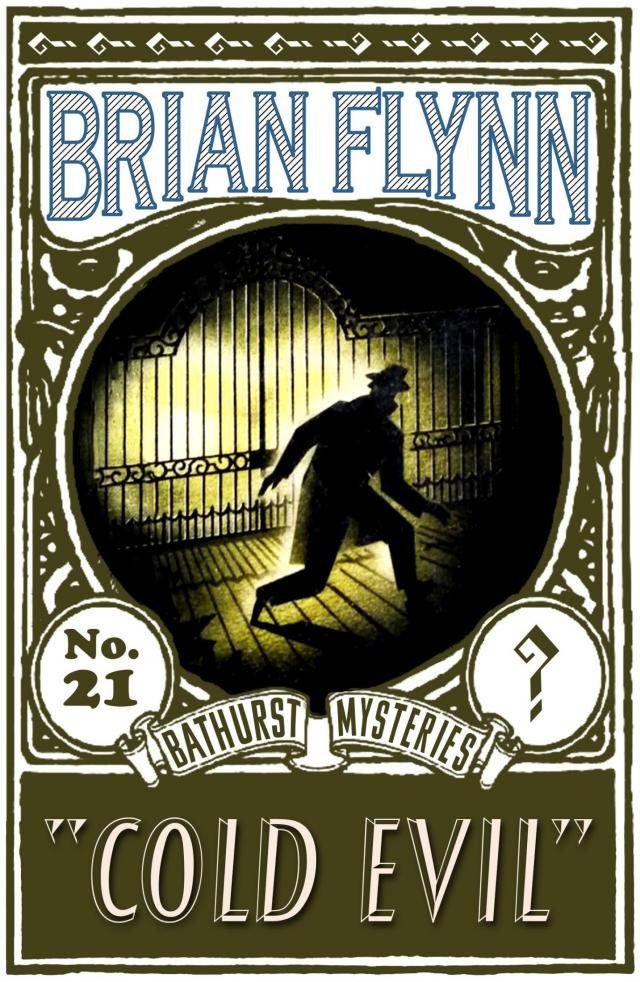
Brian Flynn
Cold Evil
“I believe those men were murdered just as clearly as if they had been stabbed to the heart with a knife. The only sign that they bore was a dull red mark . . . behind the ears.”
Six men meet at the vicarage of St Crayle one evening to tell each other ghost stories. In particular, it is Martin Burke’s tale, one of a homicidal chimera in India, that chills his audience to the bone. Burke believes that the events in the story might be a demonstration of pure evil.
This is soon revealed to be a prophecy of sorts, when one of the men disappears that very night, walking home across Constanton Moor. His body is found a week later, without a mark on him, save a look of sheer terror on his face – and a dull red mark behind his ear.
Cold Evil was first published in 1938. This new edition features an introduction by Steve Barge.
Contents
Cover
Title Page/About the Book
Contents
Introduction by Steve Barge
Chapter One
Chapter Two
Chapter Three
Chapter Four
Chapter Five
Chapter Six
Chapter Seven
Chapter Eight
Chapter Nine
Chapter Ten
Chapter Eleven
Chapter Twelve
Chapter Thirteen
Chapter Fourteen
Chapter Fifteen
Chapter Sixteen
Chapter Seventeen
Chapter Eighteen
Chapter Nineteen
Chapter Twenty
Chapter Twenty-One
Chapter Twenty-Two
Chapter Twenty-Three
Chapter Twenty-Four
Chapter Twenty-Five
Chapter Twenty-Six
Chapter Twenty-Seven
Chapter Twenty-Eight
Chapter Twenty-Nine
About the Author
Titles by Brian Flynn
Copyright
Introduction
“I believe that the primary function of the mystery story is to entertain; to stimulate the imagination and even, at times, to supply humour. But it pleases the connoisseur most when it presents – and reveals – genuine mystery. To reach its full height, it has to offer an intellectual problem for the reader to consider, measure and solve.”
Brian Flynn, Crime Book magazine, 1948
Brian Flynn began his writing career with The Billiard Room Mystery in 1927, primarily at the prompting of his wife Edith who had grown tired of hearing him say how he could write a better mystery novel than the ones he had been reading. Four more books followed under his original publisher, John Hamilton, before he moved to John Long, who would go on to publish the remaining forty-eight of his Anthony Bathurst mysteries, along with his three Sebastian Stole titles, released under the pseudonym Charles Wogan. Some of the early books were released in the US, and there were also a small number of translations of his mysteries into Swedish and German. In the article from which the above quote is taken from, Brian also claims that there were also French and Danish translations but to date, I have not found a single piece of evidence for their existence. The only translations that I have been able to find evidence of are War Es Der Zahnarzt? and Bathurst Greift Ein in German – The Mystery of the Peacock’s Eye, retitled to the less dramatic “Was It The Dentist?”, and The Horn becoming “Bathurst Takes Action” – and, in Swedish, De 22 Svarta, a more direct translation of The Case of the Black Twenty-Two. There may well be more work to be done finding these, but tracking down all of his books written in the original English has been challenging enough!
Reprints of Brian’s books were rare. Four titles were released as paperbacks as part of John Long’s Four Square Thriller range in the late 1930s, four more re-appeared during the war from Cherry Tree Books and Mellifont Press, albeit abridged by at least a third, and two others that I am aware of, Such Bright Disguises (1941) and Reverse the Charges (1943), received a paperback release as part of John Long’s Pocket Edition range in the early 1950s – these were also possibly abridged, but only by about 10%. They were the exceptions, rather than the rule, however, and it was not until 2019, when Dean Street Press released his first ten titles, that his work was generally available again.
The question still persists as to why his work disappeared from the awareness of all but the most ardent collectors. As you may expect, when a title was only released once, back in the early 1930s, finding copies of the original text is not a straightforward matter – not even Brian’s estate has a copy of every title. We are particularly grateful to one particular collector for providing The Edge of Terror, Brian’s first serial killer tale, and another for The Ebony Stag and The Grim Maiden. With these, the reader can breathe a sigh of relief as a copy of every one of Brian’s books has now been located – it only took about five years . . .
One of Brian’s strengths was the variety of stories that he was willing to tell. Despite, under his own name at least, never straying from involving Anthony Bathurst in his novels – technically he doesn’t appear in the non-series Tragedy at Trinket, although he gets a name-check from the sleuth of that tale who happens to be his nephew – it is fair to say that it was rare that two consecutive books ever followed the same structure. Some stories are narrated by a Watson-esque character, although never the same person twice, and others are written by Bathurst’s “chronicler”. The books sometimes focus on just Bathurst and his investigation but sometimes we get to see the events occurring to the whole cast of characters. On occasion, Bathurst himself will “write” the final chapter, just to make sure his chronicler has got the details correct. The murderer may be an opportunist or they may have a convoluted (and, on occasion, a somewhat over-the-top) plan. They may be working for personal gain or as part of a criminal enterprise or society. Compare for example, The League of Matthias and The Horn – consecutive releases but were it not for Bathurst’s involvement, and a similar sense of humour underlying Brian’s writing, you could easily believe that they were from the pen of different writers.
Brian seems to have been determined to keep stretching himself with his writing as he continued Bathurst’s adventures, and the ten books starting with Cold Evil show him still trying new things. Two of the books are inverted mysteries – where we know who the killer is, and we follow their attempts to commit the crime and/or escape justice and also, in some cases, the detective’s attempt to bring them to justice. That description doesn’t do justice to either Black Edged or Such Bright Disguises, as there is more revealed in the finale than the reader might expect . . . There is one particular innovation in The Grim Maiden, namely the introduction of a female officer at Scotland Yard.
Helen Repton, an officer from “the woman’s side of the Yard” is recruited in that book, as Bathurst’s plan require an undercover officer in a cinema. This is her first appearance, despite the text implying that Bathurst has met her before, but it is notable as the narrative spends a little time apart from Bathurst. It follows Helen Repton’s investigations based on superb initiative, which generates some leads in the case. At this point in crime fiction, there have been few, if any, serious depictions of a female police detective – the primary example would be Mrs Pym from the pen of Nigel Morland, but she (not just the only female detective at the Yard, but the Assistant Deputy Commissioner no less) would seem to be something of a caricature. Helen would go on to become a semi-regular character in the series, and there are certainly hints of a romantic connection between her and Bathurst.
It is often interesting to see how crime writers tackled the Second World War in their writing. Some brought the ongoing conflict into their writing – John Rhode (and his pseudonym Miles Burton) wrote several titles set in England during the conflict, as did others such as E.C.R. Lorac, Christopher Bush, Gladys Mitchell and many others. Other writers chose not to include the War in their tales – Agatha Christie had ten books published in the war years, yet only N or M? uses it as a subject.
Brian only uses the war as a backdrop in one title, Glittering Prizes, the story of a possible plan to undermine the Empire. It illustrates the problem of writing when the outcome of the conflict was unknown – it was written presumably in 1941 – where there seems little sign of life in England of the war going on, one character states that he has fought in the conflict, but messages are sent from Nazi conspirators, ending “Heil Hitler!”. Brian had good reason for not wanting to write about the conflict in detail, though, as he had immediate family involved in the fighting and it is quite understandable to see writing as a distraction from that.
While Brian had until recently been all but forgotten, there are some mentions for Brian’s work in some studies of the genre – Sutherland Scott in Blood in their Ink praises The Mystery of the Peacock’s Eye as containing “one of the ablest pieces of misdirection” before promptly spoiling that misdirection a few pages later, and John Dickson Carr similarly spoils the ending of The Billiard Room Mystery in his famous essay “The Grandest Game In The World”. One should also include in this list Barzun and Taylor’s entry in their Catalog of Crime where they attempted to cover Brian by looking at a single title – the somewhat odd Conspiracy at Angel (1947) – and summarising it as “Straight tripe and savorless. It is doubtful, on the evidence, if any of his others would be different.” Judging an author based on a single title seems desperately unfair – how many people have given up on Agatha Christie after only reading Postern of Fate, for example – but at least that misju dgement is being rectified now.
Contemporary reviews of Brian’s work were much more favourable, although as John Long were publishing his work for a library market, not all of his titles garnered attention. At this point in his writing career – 1938 to 1944 – a number of his books won reviews in the national press, most of which were positive. Maurice Richardson in the Observer commented that “Brian Flynn balances his ingredients with considerable skill” when reviewing The Ebony Stag and praised Such Bright Disguises as a “suburban horror melodrama” with an “ingenious final solution”. “Suspense is well maintained until the end” in The Case of the Faithful Heart, and the protagonist’s narration in Black Edged in “impressively nightmarish”.
It is quite possible that Brian’s harshest critic, though, was himself. In the Crime Book magazine, he wrote about how, when reading the current output of detective fiction “I delight in the dazzling erudition that has come to grace and decorate the craft of the ‘roman policier’.” He then goes on to say “At the same time, however, I feel my own comparative unworthiness for the fire and burden of the competition.” Such a feeling may well be the reason why he never made significant inroads into the social side of crime-writing, such as the Detection Club or the Crime Writers Association. Thankfully, he uses this sense of unworthiness as inspiration, concluding “The stars, though, have always been the most desired of all goals, so I allow exultation and determination to take the place of that but temporary dismay.”
In Anthony Bathurst, Flynn created a sleuth that shared a number of traits with Holmes but was hardly a carbon-copy. Bathurst is a polymath and gentleman sleuth, a man of contradictions whose background is never made clear to the reader. He clearly has money, as he has his own rooms in London with a pair of servants on call and went to public school (Uppingham) and university (Oxford). He is a follower of all things that fall under the banner of sport, in particular horse racing and cricket, the latter being a sport that he could, allegedly, have represented England at. He is also a bit of a show-off, littering his speech (at times) with classical quotes, the obscurer the better, provided by the copies of the Oxford Dictionary of Quotations and Brewer’s Dictionary of Phrase & Fable that Flynn kept by his writing desk, although Bathurst generally restrains himself to only doing this with people who would appreciate it or to annoy the local constabulary. He is fond of amateur dramatics (as was Flynn, a well-regarded amateur thespian who appeared in at least one self-penned play, Blue Murder), having been a member of OUDS, the Oxford University Dramatic Society. General information about his background is light on the ground. His parents were Irish, but he doesn’t have an accent – see The Spiked Lion (1933) – and his eyes are grey. Despite the fact that he is an incredibly charming and handsome individual, we learn in The Orange Axe that he doesn’t pursue romantic relationships due to a bad experience in his first romance. We find out more about that relationship and the woman involved in The Edge of Terror, and soon thereafter he falls head over heels in love in Fear and Trembling, although we never hear of that young lady again. After that, there are eventual hints of an attraction between Helen Repton, but nothing more. That doesn’t stop women falling head over heels for Bathurst – as he departs her company in The Padded Door, one character muses “What other man could she ever love . . . after this secret idolatry?”
As we reach the halfway point in Anthony’s career, his companions have somewhat stablised, with Chief Inspector Andrew MacMorran now his near-constant junior partner in investigation. The friendship with MacMorran is a highlight (despite MacMorran always calling him “Mr. Bathurst”) with the sparring between them always a delight to read. MacMorran’s junior officers, notably Superintendent Hemingway and Sergeant Chatterton, are frequently recurring characters. The notion of the local constabulary calling in help from Scotland Yard enables cases to be set around the country while still maintaining the same central cast (along with a local bobby or two).
Cold Evil (1938), the twenty-first Bathurst mystery, finally pins down Bathurst’s age, and we find that in The Billiard Room Mystery (1927), his first outing, he was a fresh-faced Bright Young Thing of twenty-two. How he can survive with his own rooms, at least two servants, and no noticeable source of income remains a mystery. One can also ask at what point in his life he travelled the world, as he has, at least, been to Bangkok at some point. It is, perhaps, best not to analyse Bathurst’s past too carefully . . .
“Judging from the correspondence my books have excited it seems I have managed to achieve some measure of success, for my faithful readers comprise a circle in which high dignitaries of the Church rub shoulders with their brothers and sisters of the common touch.”
For someone who wrote to entertain, such correspondence would have delighted Brian, and I wish he were around to see how many people have enjoyed the reprints of his work so far. The Mystery of the Peacock’s Eye (1928) won Cross Examining Crime’s Reprint Of The Year award for 2019, with Tread Softly garnering second place the following year. His family are delighted with the reactions that people have passed on, and I hope that this set of books will delight just as much.
Steve Barge
CHAPTER I
FRIDAY, DECEMBER 2ND, 10.20 P.M.
It will be as well, I think, if I go back to the evening when it all started. As Martin Burke finished his story, I can remember that Chinnery laughed uneasily. The laugh, too, was accompanied by a quick furtive glance over his shoulder in the direction of the door. Verschoyle smiled a thin, dry-lipped smile as befitted his cloth and his calling. Only the Squire, of all the party, seemed absolutely the same man when Burke’s story ended. Burke looked round at the various members of the company. To see the different effects, probably, that his recital had had upon each one of us. First of all, his eyes challenged mine.
“Well, Clyst, what about you—don’t you believe me?” he questioned.
I shrugged my shoulders.
“Why pick on me?” I countered.
“Why not?” He gave the question back to me immediately.
Verschoyle then came into the conversation. He was our host that evening, and on this account, I think, felt the position somewhat more keenly than the others. The conversation after dinner had taken such an unusual turn, and this so surprisingly, that Burke’s contribution was but a natural conclusion to it; when one drags in the occult and the weird, it’s ten to one that, from then onwards, no other topic will get a show. Verschoyle became pedantic. He seldom was able to avoid the temptation.
“The chimaera, which Burke tells us actually came to life in this Chinese village where he was located for a month, took its name from the volcano ‘Chimaera’, in Lycia.”
Chinnery touched his brow with a finger-tip.
“Am I quite mad, or have I dreamt it? Wasn’t there some connection, too, with the city of Belfast? Or am I thinking of . . . ?”
Verschoyle nodded. “You’re neither mad nor dream-laden, Chinnery. You refer, of course, to the city arms of Belfast. There you find a sea-horse . . . that is to say, a combination of horse and fish. The same form also appears on the arms of Oliver Cromwell.”
Burke showed signs of impatience.
“But look here, Edward, I don’t know that you’re—”
Verschoyle held up his hand and stopped him. “Just a minute, Martin. I’ve digressed, possibly, from the main avenue, but all the time I’ve been perfectly well aware of it. I think I can tell you what you were about to say. Let me extricate myself.”
“Go ahead, then,” smiled Major Burke encouragingly.
At that precise moment, I leant forward and threw a log on the fire. There was a swirling white mist outside and the chill of the air was beginning to invade the room.
“Thank you, Clyst.” Verschoyle waved his appreciation of my services and went on.
“The chimaera, of course, was not a sea-horse but a fabled fire-breathing monster. The Greeks found this word for it. It was a combination of lion, goat, and serpent. That right, Burke?”
Burke nodded his lean dark head. “Take a hundred per cent, Edward. Lion’s head, goat’s body, and serpent’s tail. Quite true. Sometimes, though, the serpent was more like a dragon. Mine was.”






