

Shoreline of infinity 7, p.1
Shoreline of Infinity 7, page 1


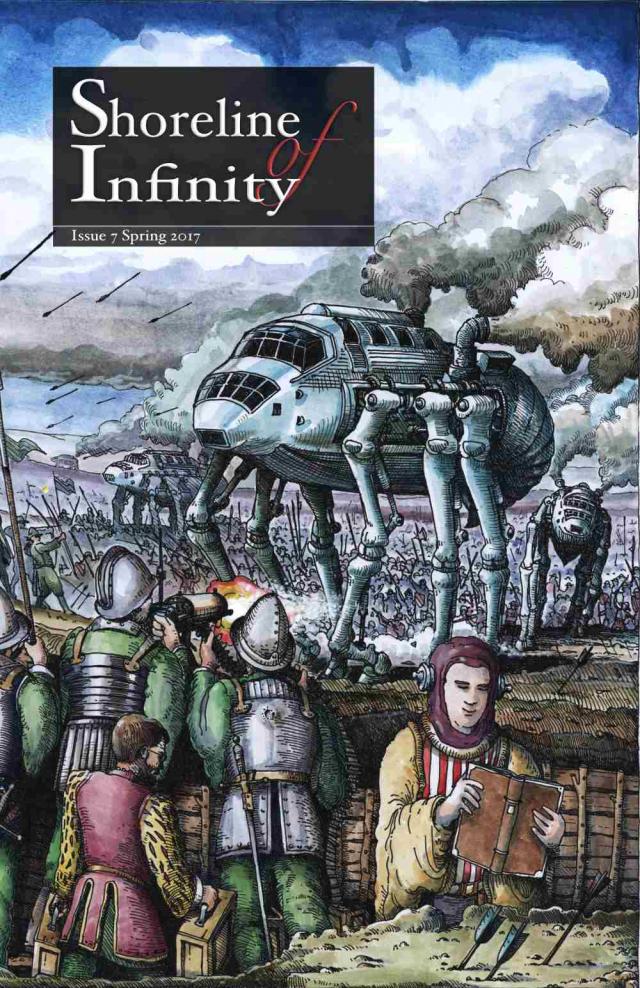
Science fiction magazine from Scotland
ISSN 2059-2590
© 2017 Shoreline of Infinity.
Contributors retain copyright of own work.
Shoreline of Infinity is available in digital or print editions.
Submissions of fiction, art, reviews, poetry, non-fiction are welcomed: visit the website to find out how to submit.
www.shorelineofinfinity.com
Publisher
Shoreline of Infinity Publications / The New Curiosity Shop
Edinburgh
Scotland
080317
Cover: Reader Embattled by Steve Pickering
Editorial Team
Editor & Editor-in-Chief:
Noel Chidwick
Art Director:
Mark Toner
Deputy Editor & Poetry Editor:
Russell Jones
Reviews Editor:
Iain Maloney
Assistant Editor & First Reader:
Monica Burns
Copy editors: Iain Maloney, Monica Burns, Russell Jones
Extra thanks to: Caroline Grebbell , M Luke McDonell, Chris Kelso
First Contact
www.shorelineofinfinity.com
contact@shorelineofInfinity.com
Twitter: @shoreinf
and on Facebook
Table of Contents
Shoreline_of_Infinity_7
The Walls of Tithonium Chasma
An Infinite Number of Me
Brother’s Keeper
Message in a Bottle
Anyone Can Ask About Enhancement
3.8 Missions
Quantum Flush
Something Fishy
The Beachcomber
SF Caledonia
That Very Mab
Interview: Jane Yolen
Multiverse
Noise and Sparks 4: The Work of the Heart
Reviews
Parabolic Puzzles
How you can Help
Back Cover
Pull up a Log
Last summer at an Event Horizon here in Edinburgh, Jane Yolen, SF poet extraordinaire and writer of many books enthralled an audience of writing students. We were therefore delighted when she agreed to talk to our Poetry Editor Russell Jones for this issue of Shoreline of Infinity. You can read about her thoughts on poetry, her strong female characters, YA fiction and writing being about “tell the True”. And better—we share four of her poems, dear reader, for you to hear her distinctive voice call out to you. We at the Shoreline of Infinity yurt are looking forward to Jane’s return visit to Scotland in the summer.
Arrival was the best SF film of 2016; no arguments, thank you. Last week I finally read the source—Ted Chiang’s short story: Story of Your Life. It showed once again how a short science fiction tale can be, at its finest, a condensed explosion of ideas, character and story. A quick Tweet brought a list of other short stories adapted for films (thanks folks!), from Sentinel for 2001: A Space Odyssey, to a tweet pointing out that Philip K Dick stories saw many transformations into films.
So Nolan, Spielberg, Wachowskis, Zemekis and all, I hope you’ve subscribed to Shoreline of Infinity—your next blockbuster film could be right here in your hands.
Noel Chidwick
Editor-in-chief
Shoreline of Infinity
March 2017
The Walls of Tithonium Chasma
Tim Major
Art: Jessica Good
Halliday pauses at the window that curves around the loading bay of Tharsis Foxglove. His bare arms reflect the pale red of the sky. The nicks and cuts on the window, the result of dust storms, are a complex net.
Are the sculptors really still out there? He imagines the three of them, free of the suffocating atmosphere of the base. Working, or just patrolling the surface aimlessly. It would be difficult to blame them if they never returned.
He continues along the curved passageway, moving away from the living quarters and the rest of the team. It seems unreasonable, stashing the aye-ayes out here beside the trucks and rovers in the workshop. He traces a finger along the lockers, counting up. Ai403, Ai404, Ai405 absent serving in the chapel, Ai406. Should they have given them names? People had, with the early models, back home. But they had been companions rather than tools.
The moulded faces gaze back at him from within shrouds of dustproof sheeting. Naked as the day they were born. At the touch of a panel, Ai407 slides out, suspended by the armpits on two extending rods. Some way to sleep.
What’s the hold-up? The boot process gets slower each time. The aye-aye’s smooth mask twitches. The corners of each empty eyepit flicker with fine motor calibrations. It feels intrusive, watching an aye-aye wake. Halliday keeps still to allow its recognition software to kick in.
“Bring a trundler to the doors,” he says, “I’ll meet you there.”
Ai407 moves away, its smooth feet padding softly on the shop floor.
Once he has suited up, Halliday slides himself into the passenger seat of the trundler. Ai407 does not turn to watch him as he struggles to arrange his legs into a comfortable position.
“Let’s go.”
The aye-aye raises both of its handless arms. Each stubby end glows blue as it interfaces with the onboard navigation system. The hatch door of the workshop rises silently and then they are outside.
Copper-coloured storm clouds have gathered in the distance, beyond the Valles Marineris. Other members of the team have talked about seeing clouds like these in dreams. They say that their dreams are more vivid, these days. Halliday himself doesn’t dream, or doesn’t remember.
He turns to look at the closed bay. The hatch is invisible from outside, fitted flush to the curve of the building. Behind the loading bay the spokes and bubbles of the living quarters emerge only slightly from their protective hills of dust. The buildings are sculpted from the same dull red as the Martian rock beneath.
“There’s no chance the storm will head this way?” he says.
“There is a chance,” the aye-aye replies.
“Quantify.”
“Six per cent.”
They travel in silence until they reach the end of the dirt track from the base. Halliday realises that he has always thought of it as a winding driveway, as if the base is a country house on Earth. They should sculpt a row of trees to line the edges of the road, do the job properly. The trundler slows to a halt.
“Where is our destination?” the aye-aye says.
“I don’t know yet.” Halliday fishes the screen from the pocket of his suit and unrolls it on his lap. It displays a map, preprogrammed by Aitchison in logistics. The base is marked in green and their own position is a throbbing orange dart. At a point five times the distance they have travelled hangs a parallelogram outlined in black. Its edges shift constantly. “Somewhere between F4 and F7, west of Tharsis Fuchsia. Get close and we’ll take it from there.”
The ground is rougher here. Halliday lurches to one side, pushing against Ai407’s slick shoulder to right himself.
“You’re not from the chapel, right?” he says.
“No. Ai406 and below service the chapel.”
Halliday nods. A decade ago most colonists would have been horrified at the thought of religion thriving on Mars. When the Foxglove council had displayed the blueprints for the chapel sculpture, the reaction back home had been one of polite disgust.
He looks outside as they push through the first of the half-pipes that lead to the plains. Its sculpted walls are perfectly smooth. Only the upper edges are frayed, where the regolith has been scooped and shifted by the wind.
He glances at the moving shape on the screen. “Hey, aren’t you all on the same network? All of you aye-ayes, and the sculptors?”
“Yes, we share bandwidth.”
“Aitchison says there are three missing. They left last week to begin sculpting the new storehouse, west of here. Can you hear them?” He slides a finger along one of the blades at the edge of the map to reveal Aitchison’s brief. “They’re models SC33 to 35.”
Ai407 turns its head as if straining to listen. “They’re out on the periphery. I can barely feel them.”
“They’ve been out there for days. What are they doing?”
Ai407’s smooth lips move before speaking, as if rehearsing a response. “Sculpting.”
Once they have crossed the sculpted bridge that connects Foxglove to the other regions, they emerge onto the plains proper. The sunlight, though filtered through the cloud of red dust and the tinted windscreen, stings Halliday’s eyes. He feels a sense of freedom at seeing the bare rocks that litter the desert to either side. They are unsculpted, unchanged, unchanging. Tharsis Foxglove will never extend this far and yet they are still close enough that no new base will be constructed here either. This space will remain preserved, an area of natural beauty, or perhaps natural ugliness.
The trundler finds a smooth route. The jolting lessens.
“Stop here.” Halliday pushes his way out of the vehicle and kneels, one gloved palm on the ground. The regolith is hard and compacted. It must have been pressed flat by the sculptors.
Back in the passenger seat he says, “Keep to the same route they took. Should prevent us from hitting any dead ends.”
They reach a rise. From here Halliday can see the smoothed route winding west around the boulders. It is less direct than seems optimum. He remembers Sunday outings on his father’s motorbike, to Ullswater and beyond. His father would say, “Never take the dir ect road when there’s a scenic route in the offing”.
The trundler gathers speed as it sweeps downhill. The parallelogram on the screen shrinks.
“We’re closing in on their location.” Halliday watches as the shape dwindles to a point. Soon, it is replaced by three faint blue specks in a cluster.
“Hey, stop. We’ve overshot them somehow.” He looks out of the rear window. The desert is vast and light. None of the boulders are large enough to hide a sculptor.
He jabs at blades onscreen, pulling up the brief and then the nav calibration. He swings open the door and clambers up onto the roof of the vehicle. From here he can see that the terrain ahead is not as blank as the desert behind them. A dark ripple crosses the horizon. A canyon. The sculptors must be somewhere below them.
“How close are we to Ius Chasma?” he says.
“The nearest tributary canyon is one kilometre from here, directly ahead.”
“Keep driving. Follow the road.” Halliday has never ventured as far as the Valles Marineris, despite the proximity of Foxglove to some of the canyons. He looks down. Without being conscious of it, he has buckled his restraining seatbelt.
At the mouth of Ius Chasma the smoothed route takes a dogleg turn. The trundler stops at the summit and Halliday stares into the depths of the canyon. The rock walls are more orange than red.
“The road continues downwards,” the aye-aye says.
“Take it,” Halliday says.
The descent is giddying. The sculptors have only flattened an area wide enough to allow themselves to return without obstacle. The right caterpillar tread of the trundler runs on rougher ground, close enough to the edge to make Halliday grit his teeth.
“They’re scheduled to be way east of here,” he says, trying to distract himself. “Equidistant between Foxglove and Fuchsia, that was the council brief for the storehouse. And they haven’t even started building. What the hell are they doing down here?”
The aye-aye pauses before answering. “Sculpting.”
They reach the floor of Ius Chasma. Halliday wipes his forehead with the arm of his suit. The trundler lurches from side to side. The smooth road now winds in tighter turns than before.
“Forget the road,” Halliday says, “Just follow its general direction.”
The right wall of the canyon is a steep hill of rubble. It must be the result of landslides. Sunlight plays on the wall to the left of the trundler but the floor is in shade. Halliday glances down at the screen. The three dots are to the east, close. He sees the Foxglove bridge arc above. They have backtracked to arrive beneath their earlier route. These canyons criss-cross more than he realised.
“We are entering Tithonium Chasma,” the aye-aye says.
Until now the walls have appeared fractured and rough. Here, their surfaces look as smooth as the sculpted road. A light swirl of ash dances ahead of them. Red-hued light blooms from a semi-circular passage.
Ai407 turns its blank face towards Halliday.
“What’s that look for?” he says. “Carry on, that way.” He points ahead, then pulls his hands under his thighs. He feels suddenly conscious of the aye-aye’s own stubby limbs.
Red light bathes the trundler as they enter the passage. Before Halliday’s eyes have adjusted to the light he hears a noise that is tinnier than the hum of the motor. It sounds like a mouse scratching below floorboards.
The walls of Tithonium Chasma are pillar-box red. The canyon is enormous, as if this is the true Martian surface and everything above is mountainous.
He sees the squat, tractor-like sculptors immediately, even though they are dwarfed by the rockface. One of them scratches at the right wall of the canyon. A cloud of dust rises around its suction funnel. The other two are facing away from the trundler as if surveying the work of their colleague.
Halliday peers up at the walls. Breath fogs the inside of his helmet, clearing from the top down. First he sees a sculpted stone bicycle that leans against a boulder. Further along the canyon, stepping stones dot a stream with static, sculpted wave crests. A young boy is frozen mid-leap with just the tip of one shoe touching rounded stone.
He cranes his neck. Standing apart from the canyon wall is a structure that towers above him, somehow too large for him to have noticed straight away. It is a steep hill with more stone waves lapping at its base. On top of the hill is a sculpted building with sheer sides that reflect the red light. Its towers are almost the height of the canyon walls.
He senses Ai407 standing beside him. The aye-aye is staring upwards at the wall where the sculptor is still at work. Here, the rock has been carved into less representative forms. It takes Halliday several seconds before he sees that it is the enormous figure of a man. His body is distorted, bent forward into a loping run. Flames surround his head like a lion’s mane. His mouth is wide open and twisted in agony.
“Jesus,” Halliday says. His voice is little more than a breath, “What is this?”
He flinches as Ai407 says, “It is a nightmare.”
“But who the hell has nightmares like that?”
The aye-aye shields its eyes.
“I do.”
*
Halliday forces a smile as Reverend Corstorphine steeples his fingers and settles into his chair, which is the only fully complete item of furniture in the chapel. Though the structure of the building was completed a month ago, backlogs at the Sandcastle sculpting foundry have delayed the pews. Only a hanging tapestry smuggled from Earth interrupts the bare white walls. It is embroidered with the words, ‘The sky above proclaims his handiwork’.
“I have long suspected as much,” Corstorphine says. The chair creaks.
“That they have nightmares?” Halliday says.
Corstorphine chuckles. “Your sons and your daughters shall prophesy, and your young men shall see visions, and your old men shall dream dreams.”
Halliday wishes that there were a desk to separate them. “Except the aye-ayes aren’t sons and daughters, or men, young or old.”
In the opposite corner of the chapel, beside a tea tray on the floor, a kettle comes to the boil. Corstorphine crosses the room and bends to fill two mugs, handing one to Halliday. “It’s only instant, I’m afraid.”
Halliday accepts the mug and wishes he hadn’t. He would prefer to take nothing from Corstorphine. People like him charge interest on a debt, however small. Before he knows it, he’ll be given chapel duties like the rest of the team. He had been rash to approach the Reverend with his findings. It had been a moment of weakness.
Corstorphine sips his drink noisily, then rests the mug on his belly. “Dreams are only echoes. Expressions of an experience not fully processed. The dreams are not the thing. Tell me again what you saw.”
Halliday describes the scene at Tithonium Chasma again. It is easy, as he has thought of it often in the days that have passed. The boy in the stream, the castle, the burning man. What can it mean?
When he finishes, he rubs his face. He has drunk the coffee without realising it. “It’s a vision of Earth, that much is clear. And, as far as I know, Foxglove’s aye-ayes were constructed back there, then shipped over with the rest of us. But that doesn’t really explain anything. What do you make of it all?”
“Well. I’m happy to say that it supports a pet theory of mine,” Corstorphine says. “I must thank you for coming to me with this information.”
Smug bastard. Halliday resents the bait but takes it anyway. “What’s your theory?”
The Reverend’s eyes travel upwards. Above him is only a prismatic white space.
“That the aye-ayes possess souls.”
*
After Halliday awakens it, Ai407 stands loose-limbed in the centre of the workshop. Sleepy and sulky. It waits for him to speak.
“Who is your father?” Halliday says, finally.
Ai407 doesn’t answer.
Maybe he phrased the question badly. He bends to look into Ai407’s sunken eyepits. “Who is your AI template?”
The aye-aye replies instantly. “Felix Ransome, the son of Professor Elias Ransome.”
Halliday gasps. “The Elias Ransome?”
“Professor Elias Ransome.”
So these aye-ayes were among the first on Mars, or at least their AI subroutines were. All this time, Halliday has been working alongside antiques.
Back on Earth, twenty years ago, Elias Ransome had been a key player in aye-aye technology. He worked for years, developing faster and more efficient chips and behaviour routines. But the true breakthrough wasn’t an issue of computing power. Ransome bestowed on the aye-ayes the gift of imagination.






