

Wilderness double editio.., p.1
Wilderness Double Edition 21, page 1


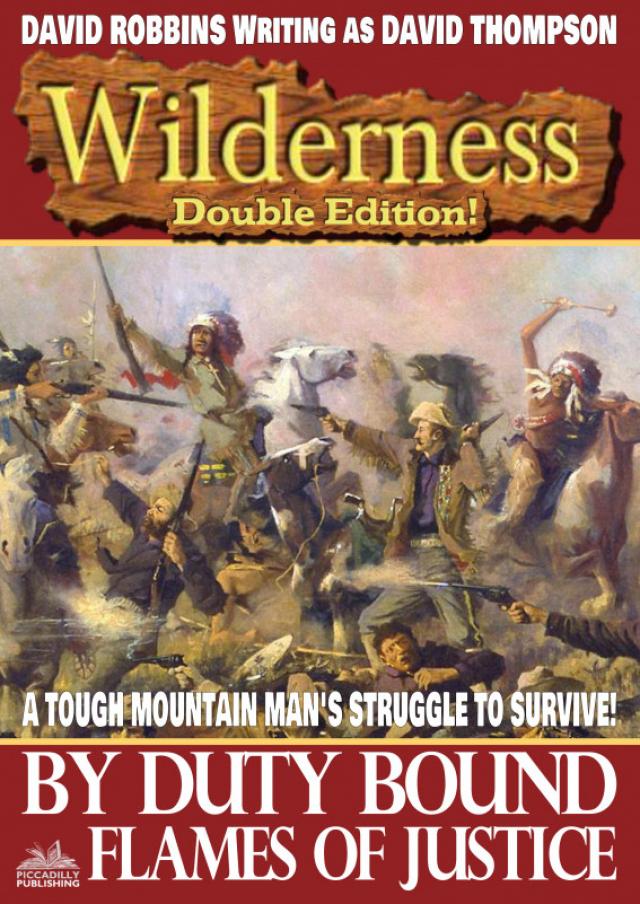
By Duty Bound
Of all the untamed places on the American Frontier, the Rocky Mountains might be the most dangerous and the least welcoming. But that’s where young Lieutenant Phillip Pickforth must go. He’s been ordered to lead a detachment from distant Fort Leavenworth to investigate reports of a vicious massacre. Reports blame the Shoshones, and the alleged ringleader of the slaughter is...Zachary King, half-breed son of famed mountain man Nate King. As Lieutenant Pickforth fights his way across the plains, he begins to realize there is much more to the situation than he's been told. And he wonders if even a detachment of soldiers will be enough when he has to face Nate and Zach King.
Flames of Justice
In the untamed wilderness of the Rocky Mountains, there is frequently only one law … the law of survival. But sometimes even the brave men and women living on the brutal frontier must answer to the justice of so-called civilization. This is the lesson that famed mountain man Nate King and his son, Zach, are about to learn. Zach, a half-breed, has been brought to trial, accused of being the ringleader of a blood-drenched Indian massacre at a trading post. Nate knows that his son is innocent and can't understand how anyone would ever think Zach could be guilty of such a crime. But Nate isn't aware of the devious plotting and scheming that's going on behind locked doors … or the horrible lengths that the schemers would go to in order to see Zach hanged!
WILDERNESS DOUBLE EDITION
41: BY DUTY BOUND
42: FLAMES OF JUSTICE
By David Robbins Writing as David Thompson
First Published by Leisure Books in 2003
Copyright © 2003, 2019 by David Robbins
First Digital Edition: August 2019
Names, characters and incidents in this book are fictional, and any resemblance to actual events, locales, organizations, or persons living or dead is purely coincidental. All rights reserved. No part of this book may be reproduced or transmitted in any form or by any means, electronic or mechanical, including photocopying, recording or by any information or storage and retrieval system, without the written permission of the author, except where permitted by law.
This is a Piccadilly Publishing Book
Series Editor: Mike Stotter
Text © Piccadilly Publishing
Published by Arrangement with the Author.
WILDERNESS 41
BY DUTY BOUND
Dedicated to:
Judy, Joshua, and Shane.
Crystal, Becky, and the Midge.
And let's not forget Kattykins, Bubbles, Libs, Russ, Steve M. & Helen, SB, Mark, Lori, Jason, Tim, Faz, Dee, Bob & Sue,
and all the rest of the wildest bunch since Butch and Sundance.
Author’s Note
Most WILDERNESS books are based on the journals of Mountain Man Nate King and the diaries of his wife and daughter
The story you are about to read is different in that its source is the private journal of Lieutenant Phillip J. Pickforth. The scion of a wealthy family, he left his life of luxury for the military, and after graduating from West Point, he was sent to Fort Leavenworth.
The Kings have a prominent part in his account. Few men had as pivotal an impact on their family, and to fully understand why, his side must be told.
Numerous references Pickforth made to his parents and siblings, and other personal matters, have been deleted. The rest of his narrative is largely intact, and the styling and wording are essentially his.
After careful consideration, I have retained his odd habit of talking to himself, or to an imaginary acquaintance, because of the insight it gives into his character.
Publisher’s Note
In keeping with the author’s wish to remain authentic., the spellings contained within the journal are as the original.
One
I was adrift in the bliss of my afternoon nap when the orderly came to fetch me. It was Corporal Fiske, and I keenly resented his smirk.
“Sorry to disturb you, Lieutenant. But the colonel would take it as a personal favor if you could pry yourself from your pillow and pay him a visit.”
Why do enlisted men feel compelled to belittle their superiors every chance they get? The corporal was typical. He looked down his nose at everyone above the rank of sergeant-major for no other reason than that they were officers and gentlemen. I gave him my sternest stare and indignantly responded, “I am certain those were not his exact words, Corporal. Repeat them verbatim.”
“Ver-what sir?” He was genuinely puzzled.
“Verbatim means word for word, Corporal. Had you stayed in school past the third grade, you would know that.”
“Begging your pardon, sir, but I got as far as the sixth grade. My teacher, Miss Petry, could speak French and knew Latin, but she never used some of the words you throw at us. Sir.”
He added that last as a slur against my four years at Princeton. I was aware some of the men were jealous of my higher learning, and although I tried not to make a show of my intellect, I couldn’t help it they were such dunces. “The colonel’s exact words, if you please.”
“ ‘Have Lieutenant Pickforth report to me without delay,’ ” the corporal quoted.
By then I had my uniform buttoned and my hat on. “Let’s not keep him waiting then, shall we?” I followed him across the parade ground to headquarters. Fiske announced my arrival and I was promptly admitted.
I must confess that Colonel Templeton was not an ideal officer. He was much too informal with the men, for one thing, and tended to be too lenient in dispensing discipline. Perhaps his age made him soft. In another year he was eligible to retire, and rumor had it that he planned to settle in Oregon Country and start a pear orchard. Now I ask you, is that any fit enterprise for a military man?
“Have a seat, Phillip,” Templeton said with a negligent gesture at several chairs in front of his cluttered desk. That was another thing about him. He was much too sloppy in his habits.
“Thank you, sir,” I said formally, and sat as stiff as a ramrod, as befit someone of rank.
Colonel Templeton rifled through a stack of papers, then looked up. He seemed deeply troubled and studied me a while before saying, “Do you like it here at Fort Leavenworth?”
“What is there to like, sir?” I answered honestly. “Our quarters are spartan, our food is barely worthy of the name. We waste far too much time in drills and on parade when we should be out in the field campaigning against hostiles. The heat is atrocious and saps a man’s vitality, and the humidity is—” I had more to complain about, but he stopped me by lifting a hand.
“I take it that’s ‘no.’ ” The colonel sighed and leaned back. “I suppose to someone with your background conditions here would be primitive.”
“Sir?”
“Come now, Phillip. We both know your family is enormously wealthy. Your father is a senator.”
“My background, as you call it, sir, has no bearing on my assessment of the post. And for your edification, I have severed ties with my father and have not heard from him in several months.”
“Oh?” Colonel Templeton tapped an envelope on his desk. “He writes me regularly to request updates on your performance.”
I was so mad, I must have flushed red.
“Would you mind telling me why you severed ties?” When I did not answer right away, the colonel added, “Consider this a personal request, not an order. I never pry into the private affairs of those under me unless it directly relates to their duties.”
“In that case, sir,” I responded, “I would rather not say.” I couldn’t get over it. Once again my father was meddling, when I had made it as plain as plain can be that I wanted to make a go of it on my own.
“Very well,” Colonel Templeton said. “Let’s get on with it.”
“With what, sir?” I said, eager to talk about something else.
“As you are probably aware, Captain Keane is on routine patrol. Captain Dugan is escorting a wagon train as far as South Pass, while Captain Tyler is dealing with some trouble involving the Pawnees. Captain Frazier is in the infirmary, and Captain Hindeman won’t be back from his furlough for another ten days.” I did not quite see the point to all this, and made a comment to that effect.
“My point, Phillip, is that all of my experienced officers are otherwise engaged when I have need of them. Major Bannister is still here, of course, but when I leave for Washington in a week to testify at a government inquiry, he assumes command in my absence. So the assignment I have in mind must be given to a junior officer. Are you interested?”
I almost came out of my chair. “Need you ask, sir?” I had been there four months and had not once been sent beyond the gate.
“To be honest, Phillip, I haven’t quite made up my mind. It’s extremely dangerous, if I say so myself. It would entail leading a column to the Rocky Mountains and conducting an investigation into an alleged massacre.”
The Rockies! I could have whooped with glee. Long ago I had heard wondrous and exciting tales about those faraway ramparts and the legion of fierce beasts and bloodthirsty heathens inhabiting them. I would give anything to see the Rockies with my own eyes. To venture where few whites had ever gone. But to avoid appearing childish, I restrained my enthusiasm and said, “A massacre, sir?”
“Yes. Word has reached us that a trading post was overrun and the civilians slaughtered.”
“How many were killed, sir?”
“Seven, according to our informant.”
“And the culprits, sir?”
“Supposedly the Shoshones.” Colonel Templeton paused. “Are you at all familiar with the various tribes, Phillip?”
“I’ve read all the required reports, sir.” I racked my brain for every mention I ever heard of them, and one kernel of information stood out. “Aren’t the Shoshones supposed to be friendly, sir?”
“None friendlier. They’ve gone out of their way to maintain peaceful relations with us. There has never been a single instance of a Shoshone attacking a white man. Which, as you can readily understand, makes our informant’s information suspect.”
“Who is this informant and when do I meet him, sir?”
“His name is Borke. Phineas Borke. His brother was head of the trading post. He’s due back here in two hours. I expect you to be here to hear what he has to say.”
“With pleasure, sir.”
The colonel seemed to choose his next words with care. “We must proceed with caution in a circumstance like this, Phillip. It would not do to incite a friendly tribe to violence if they have been unjustly accused.” Rising, he turned to a large wall map. “Look at it, Phillip. Thousands of square miles of untamed wilderness, over which we’re expected to preserve order with a few hundred men. It’s an impossible task. The army is talking about building more forts farther west, an action I’ve endorsed for years, but until then Fort Leavenworth is the last bastion between the Mississippi River and California. We have been entrusted with a powder keg that might blow up in our faces at any moment.”
I was well aware of the situation and mildly resented being lectured to, but he was my commanding officer and I was obligated to endure it.
The colonel reached up to tap a spot high on the map. “Up here we have the Blackfeet, or, to be more exact, the Blackfoot Confederacy.” He tapped another spot. “Here we have the Sioux. Here the Cheyenne. Here the Arapahos. Here are the Utes. Down here the Apaches. In Texas, the Comanches. Tribes who have shown themselves to be inimical to white intrusion.”
I had to admit that the colonel’s vocabulary at times was equal to mine, which is no mean feat of mental accomplishment.
“Mark my words, Phillip. As time marches on and more and more of our people seek their fortunes in the West, more and more of them will lose their lives to unfriendly Indians. It’s inevitable. Just as it’s inevitable we can’t keep a lid on things at our current state of readiness. There should be twenty forts stretched from Canada to Mexico, and even that would not begin to give settlers the protection they need.”
All this was old hat. I had listened to his pet spiel many an evening at the mess hall.
“Discretion is called for, Phillip. We must try, as much as possible, to remain on friendly relations with the Indians. Some, like the Blackfeet, hate us outright and will never live in peace. Others, like the Shoshones, have offered us the hand of friendship, and we are duty-bound to reach out and accept that hand.”
I cleared my throat. “I understand what you’re saying, sir. I mustn’t permit myself to jump to conclusions.”
Colonel Templeton looked at me. “There is more to being an officer than following orders. Good officers learn to think for themselves. To go by the book, but to bend the book when the situation warrants.”
“Bend the rules, sir?” I was aghast. The very idea went against everything I had been taught, and, indeed, against my own temperament. Rules were made to be obeyed. Without exception. Without question.
“That will be all for now, Phillip,” the colonel dismissed me. “Report back in two hours and I will introduce you to Mr. Borke.”
Far be it from me to be critical of others, but Phineas Borke was as slovenly an individual as I ever met. He was round of body and round of face and had a greasy, sweaty complexion that was most unappealing. I didn’t let on how I felt when we were introduced, and after shaking his hand, took the proffered seat.
Borke wore homespun clothes in need of several washings to be anywhere near clean. His fingernails were filthy, his boots scuffed. When he talked, I noticed he had a piece of food stuck between his front teeth. At one point he casually flicked it out, and it landed close enough to my chair to make me queasy.
“As I was just tellin’ your superior, here, Lieutenant, I’ve come to the army as a last resort. My brother’s blood screams for vengeance, and you’re the only jaspers in a position to see he gets it.”
“You were close to your brother, I take it?” I asked. “Like two peas in a pod,” Borke declared. “Why, if it hadn’t been for a busted leg, I’d have gone with him. And right now I’d be pushin’ up grass, same as him. God rest his soul.”
“Perhaps you would be so kind as to repeat your story to the lieutenant?” Colonel Templeton suggested.
“Glad to.” Borke hooked his pudgy thumbs around his suspenders. “You see, my older brother Artemis had himself a brainstorm a while back. He’d heard about how much money tradin’ posts make and figured he could turn a hefty profit if he could set one up where it would be safe from rovin’ hostiles. Well, word has it there aren’t any Injuns anywhere friendlier than the Shoshones, so he reckoned to set his tradin’ post up in their territory.”
“His proposal sounds eminently feasible to me,” I commented.
Borke cocked his head. “What did you just say?”
“I said it sounds like a good idea.
“Oh. You could have fooled me.” Borke cleared his throat. “Anyhow, brother Artemis rounded up some good boys to go with him. Six mother’s sons as fearless as he was. They took ten pack animals loaded with trade goods and whatnot, and struck off for the Green River country.”
“Without letting us know,” Colonel Templeton commented.
“The last time I saw him,” Borke went on, “Artemis shook my hand and promised to come back with more money than either of us had ever seen in all our born days.” He stopped and bowed his head. “I miss him somethin’ terrible.”
I could see the man was grief-stricken, but Colonel Templeton said rather harshly, “How did your brother plan to acquire all this money? The fur trade collapsed years ago. And not much else the Indians can trade is of much value.”
“It’s no secret, though, that tradin’ posts generally make sizable profits,” Borke stated.
“They should,” Colonel Templeton said. “Most traders mark up their merchandise anywhere from twenty-five to fifty percent, the dishonest ones even more.”
“Wait a second, Colonel. Are you implyin’ Artemis was up to no good? That he was fixin’ to cheat the Injuns?”
“Don’t put words in my mouth, Mr. Borke. I simply noted your brother’s expectations were unrealistic. Be that as it may, we view your alleged account of a massacre with the utmost concern.” The colonel was now studying Borke as intently as he previously studied me. “Which brings to mind a pertinent question. How is it you learned the details of the atrocity when your brother and all those with him were slain?”
“Someone saw the whole thing. An old mountain man named Hyde. He heard about the tradin’ post and rode down from his cabin in the high country to pay it a visit. He got there just as the shootin’ commenced.”
“You have spoken to this Hyde personally?” I inquired.
“Sure have. He’s right outside. You can ask him about it yourself.” Without waiting for permission, Borke jumped up and was out the door. He returned with the scruffiest person I ever set eyes on, a scarecrow in worn buckskins with a scraggly gray beard that fell to his thin waist.
“Jacob Hyde, at your service,” the mountain man said courteously enough.
Colonel Templeton indicated another chair. “We would very much like to hear about the Shoshone attack on the trading post, Mr. Hyde.”
“Glad to oblige. I recollect it like it was yesterday. But it ain’t rightly fair to lay the blame on the Shoshones. It was a breed led ’em, and he should be held to account as much as they should.”
“The man who instigated the slaughter was part white? You’re sure?”






