

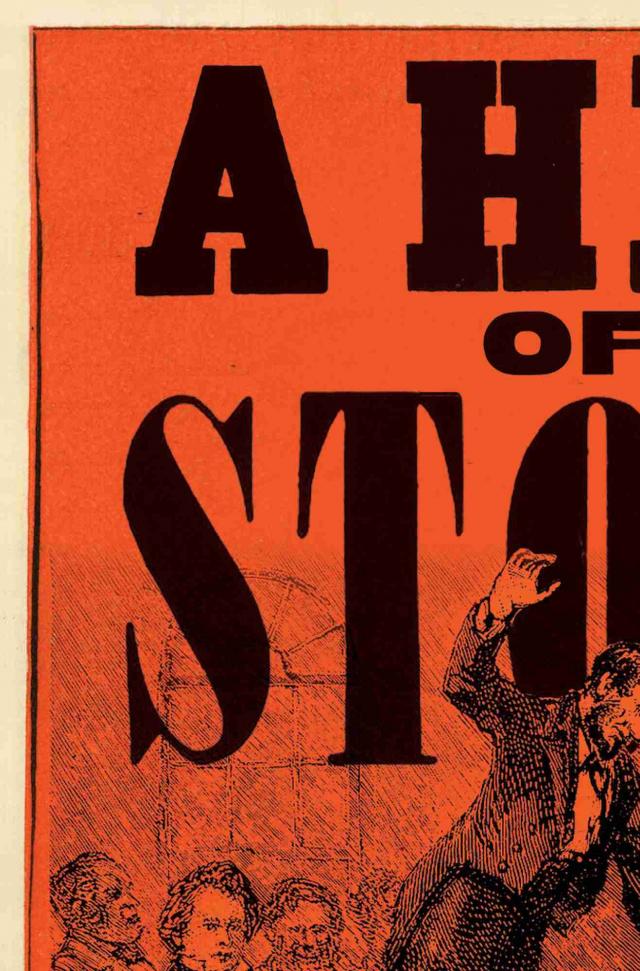
A hell of a storm, p.1
A Hell of a Storm, page 1


Thank you for downloading this Simon & Schuster ebook.
Get a FREE ebook when you join our mailing list. Plus, get updates on new releases, deals, recommended reads, and more from Simon & Schuster. Click below to sign up and see terms and conditions.
CLICK HERE TO SIGN UP
Already a subscriber? Provide your email again so we can register this ebook and send you more of what you like to read. You will continue to receive exclusive offers in your inbox.
The United States in 1854—the free and slave states are about to engage in a fierce struggle for control of those western territories acquired over the previous half century, by both treaty and war, from France and Mexico.
For My Family
We are playing for a mighty stake, if we win we carry slavery to the Pacific Ocean, if we fail we lose… all the territories, the game must be played boldly.
Missouri senator David Rice Atchison, 1855
Introduction: Right from Wrong
It is wrong… letting slavery into Kansas and Nebraska.
Abraham Lincoln, 1854
Among historians, a handful of critical dates are said to convey much of the American experience. In 1800, a little more than a decade after the Constitutional Convention, a southern-seeded Jeffersonianism came to power emphasizing the virtues of planters and plain folk, slavery and states’ rights. Parent to an ebbing agrarian order, this once formidable coalition cracked in 1860 as Lincoln’s election anticipated the coming crisis of secession and civil war that brought a budding northern industrial regime to the fore. Its congressional protectors, who would be praised in friendly Gilded Age newspapers as the “Grand Old Party,” ruled over a growing republic compromised by casual political corruption, coercive labor practices, and enormous concentrations of top-end wealth. In time these mounting ills earned the enmity of reform-minded populists and progressives who challenged its legitimacy, only to see, in the 1896 election of William McKinley, robber baron rule sink into the next century. This long run of capitalist mastery is said to have crashed in 1932 with the coming of a Franklin Roosevelt–led New Deal dedicated, in a flurry of Depression-era legislation, to building a European-style social welfare state. But then came 1968. Cultural upheaval, a widening racial divide, and an unpopular war in Vietnam upended the new liberalism and gave way, finally, to a new conservatism, emblematized in the 1980 rise of Ronald Reagan.
This lengthening bridge of landmark years offers a summarizing if obviously incomplete account of the nation’s tumultuous political past. What it offers in concision it surely lacks in precision. A generational approach does have the virtue, however, of helping us to broadly conceptualize distinctions in demography, economic development, sectionalism, and so on. Lincoln’s northern-oriented, factory-based, and Republican Party–powered America was different from Jefferson’s southern-oriented, plantation-based, and Democratic Party–powered America. And, when thinking over the period in which that transition transpired, it seems clear that 1854, even without the prod of a presidential election, proved to be both crux and constellation, a pivotal year of decision that led to immense and enduring change.
This had everything to do with the explosive Kansas-Nebraska Act, almost certainly the most lethal piece of legislation to ever clear Congress. Introduced on Capitol Hill the first week in January, it served as an unintended lightning rod for northern discontent, putting the nation irreparably on the road to civil war. The act opened the way for planters to bring their enslaved peoples to a vast tract extending from the Mississippi River to the Rocky Mountains. This area constituted the core of Jefferson’s old Louisiana Purchase (1803) and had been formerly reserved for free labor by the Missouri Compromise (1820). The bill’s patron, the squat, broad-shouldered, and shaggy-browed Illinois senator Stephen A. Douglas, a talented if recklessly ambitious politician possessed of a face, one journalist wrote, “clearly expressive of much boldness and power of will,” considered himself a champion of national development. As chairman of the upper chamber’s Committee on Territories, he anticipated opening these lands to promote the construction of a transcontinental railroad—a nonstarter, he knew, without the sanction of southern support. Though confident that he could manage this dangerous sectional dispute, Douglas appreciated that concerned Yankee constituencies were likely to protest the revered Compromise’s sudden repeal—“it will raise a hell of a storm,” he had observed at the time. And so it did.1
Over the years, historians have recognized the importance of 1854. In his popular eight-volume opus Ordeal of the Union (1947–1971), Allan Nevins described the demise of the Missouri pact as “a great catalytic agent” that had “crystalliz[ed] the nation’s parties into new forms.” James M. McPherson later speculated in his Pulitzer Prize–winning Battle Cry of Freedom (1988) that “the Kansas-Nebraska Act… may have been the most important single event pushing the nation toward civil war.” And more recently, in 2009, noted Lincoln scholar Allen C. Guelzo stated with even greater gravitas: “The Kansas-Nebraska Act of 1854 enjoys the dubious honor of being the only… legislation that caused a civil war.”2
Despite these and other like-minded assertions, there remains a broader tendency to attach the act, without emphasis, to a carefully curated inventory of provocations that led to the collapse of sectional compromise. Time-crunching textbooks in particular have long marched students through a master list of motives. These serial incitements include the Compromise of 1850, “Bleeding Kansas” (1854–1859), the Dred Scott decision (1857), the John Brown–led assault on a federal arsenal at Harpers Ferry, Virginia (1859), and Lincoln’s crucial 1860 election to the presidency.
On reflection, however, none of these usual suspects seems as essential, as elemental, to the Union’s splintering as the opening of free soil to slavery. Much of the country accepted, rather, the Compromise of 1850, which, among other provisions, recognized California’s free-state status, outlawed the slave trade in Washington, D.C., and strengthened an existing fugitive slave act by mandating Yankee aid in the return of northern-quartered runaways. Though each of these articles antagonized select constituencies, most Americans seemed eager to set their sectional quarrel aside. Accordingly, both the Democratic and Whig parties endorsed the Compromise in their respective platforms leading up to the 1852 presidential election. The former condemned agitation over slavery as the “efforts of… abolitionists… [designed] to lead to the most alarming and dangerous consequences,” while the latter declared the compact “a final settlement, in principle and in substance.” Angling for northern ballots, the Democrats, in a divided Baltimore convention, nominated former New Hampshire senator Franklin—Handsome Frank—Pierce, an unheralded dark horse whose shocked wife, Jane, detesting Washington, fainted at the disagreeable news. Affable if saddled in a grief-attended battle with the bottle (none of his three children lived beyond the age of eleven), Pierce proved satisfactory to southerners for his favorable opinion of the Compromise, which he regarded as a guarantee “that no sectional or fanatical excitement may again threaten the durability of our institutions.”3 Come November he captured the presidency in an Electoral College landslide, defeating the doughty old General Winfield Scott, a Mexican-American War hero born in the 1780s, 254 to 42, and taking twenty-seven of the thirty-one states. Democrats correspondingly increased their majority in the House of Representatives that autumn while retaining control of the Senate.
The saga of “Bleeding Kansas,” by contrast, stressed clash over consensus. This mini–civil war on the prairie between pro- and antislavery settlers could hardly have happened, of course, without the enabling legislation in 1854 that first opened the Kansas Territory—and quite possibly neither could Brown’s legendary raid. Endeavoring to arm runaway slaves and pursue a violent emancipation down the Appalachians’ piney emerald spine, Brown, an elaborately bewhiskered abolitionist warrior in the mold of an Old Testament prophet, had cut his teeth in Kansas.4 There he engaged in the notorious Pottawatomie Creek massacre, leading a small band on a nighttime raiding party during which these men murdered five ill-starred homesteaders of proslavery persuasion—afterward washing their bloody swords clean in a nearby creek. This studied slaughter, itself a retaliatory raid in recompense for a southern assault on nearby Lawrence, anticipated a series of skirmishes over the next few months in which dozens were killed.
The landmark Dred Scott decision, handed down by the Supreme Court in March 1857 and declaring, among other provisions, the Missouri Compromise unconstitutional, might also be read as a reaction to the Kansas-Nebraska Act. In effect the court put a judicial stamp of approval on what Douglas’s bill had already accomplished—protecting the property rights of slave owners. Relatedly, its architect, Chief Justice Roger B. Taney of Maryland, seemed particularly if not desperately eager to shut the door on free-soil sloganeering by upholding the plantocracy’s place in the western territories. Taney’s “growing extremism in the late 1850s,” so one scholar notes of this dominant figure on the antebellum bench, was whipped up by “the rise of the Republicans,” who continued to proclaim the sanctity of antislavery sentiment in the territories, and “whom he regarded as dangerous fanatics.”5 The Republican Party formed in 1854 to battle Douglas on the very question of slavery’s extension.
Finally, Lincoln’s path to the presidency also owed something to the Missouri Compromise’s repeal, a point the lanky Rail Splitter made public on several occasions. A former one-term Illinois Whig congressman, now five years out of politics and practicing law in the small capital city of S pringfield, Lincoln, like many northerners, was astonished when Douglas’s bill became law. “I particularly object to the NEW position which the avowed principle of this Nebraska law gives to slavery in the body politic,” he said in a speech. “I object to it because it assumes that there CAN be MORAL RIGHT in the enslaving of one man by another.” Eager to enter the fight, he hoped to return to Washington, preferably as a U.S. senator; his moral sense having been stirred by the planters’ demand to bring their bondsmen and -women west.6
If the struggle over the common territories constituted the turning point in Lincoln’s political career, it signified further the coming destruction of an older partisan order predicated on a series of imperfect sectional compromises. Only the unforeseen demise of that once sacred system threatened to raise the subject of slavery’s insertion in the West to a boiling point. And this is precisely what the Kansas-Nebraska Act carelessly accomplished. Within months of its proposal a “radical” Republican Party emerged, the conservative Whig coalition (winners of two presidential contests) went into a steep swoon from which it never recovered, and the northern wing of the Democratic Party suffered severe electoral losses for its too-blind backing of Douglas. The act more generally operated as a consciousness-raising occasion in the North while southerners, seeing the soured Yankee reaction, began to dig deeper into their own sense of honor, equity, and states’ rights. In turn, a cancerous and increasingly sectionalized war of words now made prey upon an ailing body politic. And everything that emanated after, culminating in the unprecedented December 1860 secession ordinance enacted by South Carolina, the first of eleven states to leave the Union, owed something small or large to the decisions made on slavery and territorial development during the fateful Kansas-Nebraska debates—a season of well-poisoning proceedings that produced the greatest miscalculation in American political history.
* * *
In 1854 some 26 million people lived in the United States, more than 3 million of whom were enslaved. Most Americans resided above the Mason-Dixon Line; nearly one-third of all inhabitants were New Yorkers, Pennsylvanians, and Ohioans. Of the ten cities with populations exceeding fifty thousand, only two, Baltimore and New Orleans, were southern. A majority in both sections lived on farms, a condition of subsistence they tended to equate, beyond its obvious utilitarian purposes, with independence and personal freedom. Rather than accepting merely being hirelings, they aspired to ownership. “Dependence begets subservience and venality,” Jefferson had argued, “while we have land to labour then, let us never wish to see our citizens occupied at a work-bench.”7
While both Congress and the country skirmished over the Kansas-Nebraska bill, the Boston Public Library opened in a former schoolhouse on Mason Street with a circulation of sixteen thousand volumes; the United States Naval Academy in Annapolis, Maryland, graduated six midshipmen in its inaugural class; and the Kanagawa Treaty between the United States and the Tokugawa shogunate ended Japan’s two-century policy of national seclusion. American births that year included the military march master John Philip Sousa, author of “The Stars and Stripes Forever”; George Eastman, founder of the Eastman Kodak Company, whose “roll film” made the motion picture industry possible; and Jennie Jerome, a Brooklyn-born socialite said by one admirer to possess the sable, lithe beauty of a panther, and later known to the world as Lady Randolph, the mother of future British prime minister Winston Churchill, who called her “a fairy princess [whom]… I loved… dearly—but at a distance.”8
In the American political arena, a spate of recent deaths foretold the eclipse of a once formidable congressional generation. Between the War of 1812 and midcentury, three statesmen from three sections dominated the country’s partisan affairs. Combined, these prominent politicians—Kentucky’s slim-limbed Henry Clay, a nationalist known affectionately as “Harry of the West”; Daniel Webster, a powerful (if sometimes alcohol-fueled) orator and unapologetic elitist representing greater Boston’s interests; and South Carolina’s John Calhoun, the “cast-iron man” whose tenacious defense of states’ rights made him the champion of the white South—were widely regarded as the Founding Fathers’ successors; some called them “the Great Triumvirate.”9 During their many years in power a number of sectional disputes threatened to upend the expanding Union. These included the oft-embittered deliberations that led to the Missouri Compromise, the nullification crisis of the early 1830s in which the right of states to annul federal law was vigorously debated, and the more recent struggle over slavery’s status in territory taken by the United States following the Mexican-American War (1846–1848).
Clay, a westerner who had bid in 1824 to become the first president to hail from beyond the Appalachian Mountains, orbited outside the expectations of northern and southern constituencies and seemed particularly adept at diffusing sectional tensions, winning the warm sobriquet “The Great Compromiser.” But he, along with Webster and Calhoun, was mortal after all—and all died between 1850 and 1852. Though lauded for their leadership and sainted in smooth marble statuary, they nevertheless left their political heirs a crushingly difficult situation. In the shadow of a rising Trans-Mississippi West, the time for regional resolutions had wound down; the dispute over slavery’s place in the nation’s territories neared an inevitable dilemma. A prepresidential Lincoln, finding his footing in a post-triumvirate politics, encapsulated this crisis as clearly as anyone when declaring, paraphrasing the Gospel of Matthew, “A house divided against itself cannot stand. I believe this government cannot endure, permanently half slave and half free…. It will become all one thing, or all the other.”10
How this ancestral tug-of-war began to turn decisively toward freedom during the Kansas-Nebraska brawl is the subject of this book. It explores the personalities and the politics, the writings, elections, and ideas, that upended an older America and began to make space for its successor. In 1854 Uncle Tom’s Cabin author Harriet Beecher Stowe attacked slavery’s expansion across the frontier via lectures, letters, and a mass petition campaign, while a sublime Henry David Thoreau published the iconic Walden, a deeply felt meditation on the nation’s imperfect path to transcendence, independence, and equality. It is the year southern statesmen endeavored to enlarge the boundaries of their cotton sovereignty by purchasing Cuba from Spain, even as the baby-faced Tennessee adventurer William Walker led a ragtag army into the Mexican territory of Baja California, where he audaciously declared slavery legal.
In 1854 a furious Boston convulsed under martial law as thousands of angry protesters faced thousands of armed state and federal troops charged with returning the fugitive Anthony Burns, an enslaved man escaped from Virginia, to servitude; amidst this turmoil, settlers in both sections of the country raced to the newly opened Kansas Territory, setting into motion a violent, protracted confrontation between defenders of free and chattel labor. At a Fourth of July celebration that year the radical abolitionist William Lloyd Garrison, equipped, so one observer insisted, with the brazen “loquacity of a blue-jay,” created a stir by burning a copy of the U.S. Constitution, while all through a pulsing summer scores of “anti-Nebraska” organizations began to form, thus commencing the remarkable process by which the Republican Party would come to control within a few election cycles the national government.11
The incredible year closed at length in a cadence of premonitory episodes, including Lincoln’s autumn campaign-circuit emergence as a coming political force, the stunning November elections that reduced the power of the traditional parties, and Harriet Tubman’s dramatic Christmas Day rescue of her three brothers Ben, Henry, and Robert from enslavement in Maryland’s remote Eastern Shore. This last act illustrated acutely the striking incongruities of a nation unable to remain much longer in the paralytic practice of “half slave and half free.”
A ripening awareness of sectional identity informed all these coalescing events. Beyond upending the conventional partisan approach, the Kansas-Nebraska Act profoundly affected the way that both northerners and southerners saw themselves—and each other. Among an increasing number of Yankees, the thorny notion arose that a caucus of planters presumed, by threat or fraud, to reserve the common territories for their own use. “Where,” the Boston-based Atlantic Monthly asked, “Will It End?” Henry Wilson, a Massachusetts Republican and later vice president in the second Grant administration, argued in a memoir that “the determined purpose of the Slave Power to make slavery the predominating national interest was never more clearly revealed than by the proposed repeal of the Missouri Compromise.” After a generation of concessions, he continued, a deeply shaken North at last refused to allow the South to have its way: “When… Congress had been dragooned into the adoption of the Kansas-Nebraska Act… it was supposed… that it was only a question of time when Kansas should become a slave State…. But [the bill’s champions] miscalculated. They did not fully comprehend the forces which freedom had at command, nor the purposes of Providence concerning the nation.”12






