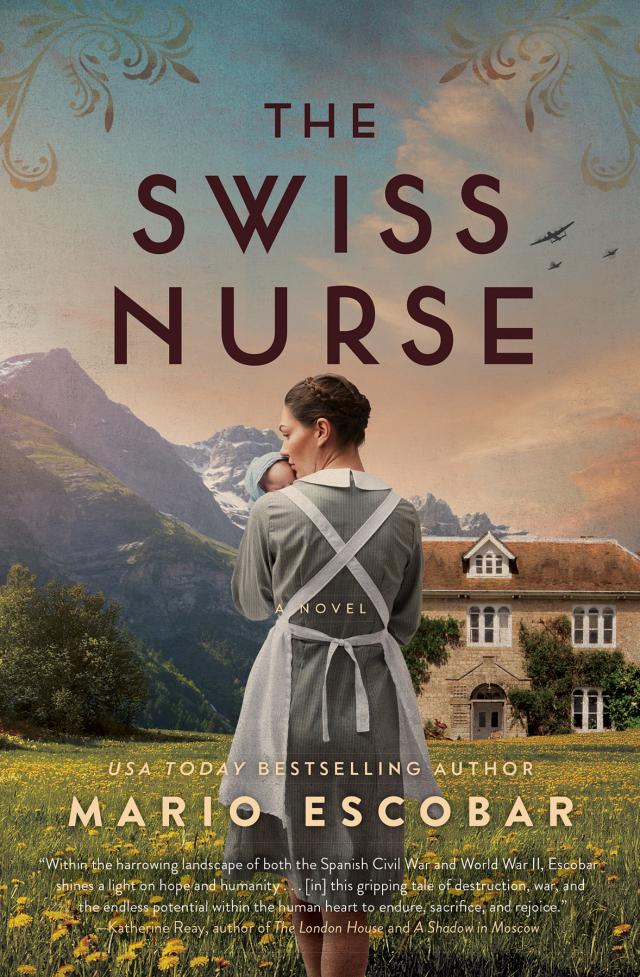
The swiss nurse, p.1
The Swiss Nurse, page 1


Information about External Hyperlinks in this ebook
Please note that the endnotes in this ebook may contain hyperlinks to external websites as part of bibliographic citations. These hyperlinks have not been activated by the publisher, who cannot verify the accuracy of these links beyond the date of publication
Dedication
To the colleagues with whom I traveled to France and discovered the Elne maternity hospital, and for the tears we shed for the lost children of the Second Spanish Republic.
To the dozens of children buried under the sand at the Argelès-sur-Mer beach, whose weeping is forever beyond consolation.
To my parents, war children who faced the hunger, fear, and humiliation of being the losers just for having been born on the wrong side.
Epigraph
The day my son was born in the delivery room at the maternity hospital, I couldn’t hold back my tears. Everyone thought I was crying from excitement, but only I knew I was crying for that child I’d seen buried under the sand at Argelès.
Mercè Domènech, Republican mother
There’s a Spaniard who wants
to live and starts living,
between a Spain that’s dying
and another that’s yawning.
Little Spaniard coming into
the world, may God keep you.
One of the two Spains
will freeze your heart.
Antonio Machado, Spanish poet
Contents
Cover
Title Page
Dedication
Epigraph
A Note from the Author
Prologue
Part I: Exile One: Isabel
Two: Isabel
Three: Isabel
Four: Isabel
Five: Isabel
Six: Isabel
Seven: Isabel
Eight: Isabel
Nine: Isabel
Ten: Isabel
Eleven: Isabel
Twelve: Isabel
Thirteen: Isabel
Fourteen: Isabel
Part II: Fences Fifteen: Isabel
Sixteen: Isabel
Seventeen: Isabel
Eighteen: Isabel
Nineteen: Isabel
Twenty: Isabel
Twenty-one: Elisabeth
Twenty-two: Isabel
Part III: The Elne Maternity Hospital Twenty-three: Elisabeth
Twenty-four: Isabel
Twenty-five: Isabel
Twenty-six: Isabel
Twenty-seven: Isabel
Twenty-eight: Isabel
Twenty-nine: Isabel
Thirty: Elisabeth
Thirty-one: Isabel
Thirty-two: Isabel
Thirty-three: Isabel
Thirty-four: Isabel
Thirty-five: Elisabeth
Thirty-six: Isabel
Thirty-seven: Peter
Thirty-eight: Isabel
Thirty-nine: Isabel
Forty: Isabel
Forty-one: Elisabeth
Forty-two: Isabel
Forty-three: Isabel
Forty-four: Elisabeth
Forty-five: Elisabeth
Epilogue
Clarifications from History
Timeline
Discussion Questions
References
About the Author
About the Translator
Acclaim for Mario Escobar
Also by Mario Escobar
Copyright
A Note from the Author
True freedom consists of escaping the prison of prejudices and conventionalisms and forming our own opinions, even if they go against the grain. This is why, in a world of extremisms and intolerance, writing books about the power of love, respect, and tolerance strikes me as a most revolutionary act. Now that the Spanish Civil War and other twentieth-century conflicts are viewed through various sectarian prisms, it is more pressing than ever to recover the antiquated values of equity, historic rigor, and love for the truth.
The Swiss Nurse is a novel based on the testimonies of dozens of refugees who crossed the French border hoping to escape certain death. The French government published the following statistics in its Valière Report from March 9, 1939: of the 440,000 Spanish refugees in southern France at the time, 220,000 were soldiers; 170,000 were women, children, and older adults; and another 50,000 were people with injuries or disabilities.
The Mediterranean beaches of southern France hosted the improvised camps thrown up by French authorities to deal with the avalanche of humanity that became known as the Retirada, or the Retreat. The French government had estimated that around 40,000 Spaniards would cross the border at the end of the war, and at a slow rate. Yet the fall of Barcelona at the beginning of 1939 kicked off one of the most severe humanitarian crises of the twentieth century.
The first camps were Argelès-sur-Mer, Saint-Cyprien, and Le Barcarès, in the department of Pyrénées-Orientales. They were barely more than sandy beaches, with a few barracks for camp administration. The earliest refugees had to improvise shelters fashioned with reeds and blankets. With no clean drinking water, poor food rations, and terrible overcrowding, death and disease spread widely.
Among the most vulnerable groups were the children, who always suffer the consequences of the terrible decisions of their elders and the horrors that war produces. Children are the expiatory victims of all human conflicts. The protagonists are their parents, grandparents, and guardians and the adults who decide to flee their countries or are forced to by circumstances. The losers of wars and conflicts go into exile. That may be their decision, but the children themselves have no honor or ideology to preserve. Their exile is in exchange for nothing. Thus they are forever forgotten in history books, novels, and movies.
Elisabeth Eidenbenz, together with the members of the Association to Aid Children in War, knew very well the horror and suffering that were unleashed during the three long years of the Spanish Civil War. She watched as many Republicans fled the Republic, which crumbled by the day. As she saw the suffering of mothers and children in the refugee camps, she decided to take action. Her travels throughout the beaches of southern France showed her the fear and desperation of women who did not even have drinking water to offer their babies. She saw mothers covering their infants in sand to keep them warm and attempting to give them seawater for their thirst. And so she opened the Elne maternity hospital to offer respite and care for pregnant mothers and their babies. Some 597 children graced the halls of the maternity hospital, and their lives were preserved. With the Nazi occupation of France and the arrival of Jewish refugees, the maternity hospital became a hub of shelter and assistance.
I visited the Elne maternity hospital in the spring of 2011. It was at the end of a trip that had taken me across half of France and became the seedbed for my book Children of the Stars. On one of the last days, I went with a group of journalists, writers, professors, and Protestant pastors to the maternity hospital. It is now a museum. Our hearts broke as we toured the various rooms and saw the videos and images of our compatriots stranded in a strange and hostile land. When our group met back up in the yard, we were all red-eyed and speechless. The story had been a punch to the gut.
In the summer of 2018, I returned to the area with my family. We visited the Argelès Camp Memorial, and I was once again bowed over with grief and sadness. My maternal grandfather may have been among those desperate souls escaping certain death. After the war he was declared missing.
The Swiss Nurse is the story of the Elne maternity hospital and some of the women who found in that peaceful haven enough hope and strength to keep going.
I hope this book offers a glimpse of what is freest and most authentic about humanity, both in our tremendous humanity and in our destructive inhumanity. This is the story of one dark moment and the bright light that certain people give off in defiance of the darkness of a fanaticized world.
Madrid, September 1, 2021
Prologue
Cleveland, Ohio, United States
December 24, 1995
I had always been aware of the fleeting nature of life. This anxious sensation drove me to rush each minute as if any second could be my last. When we would visit my grandmother Isabel at her house outside of town and by the sea, she would always say that as time marched inexorably on, all the people we had ever loved went slowly and quietly by the wayside. Our parents, friends, and teachers disappeared from our lives and never returned. Her words made an impression on me, though I was too young to understand the void of forgetfulness. But I liked listening to her talk. She had a strange accent, and I would listen while staring at the crackling fire in the hearth. That is when I felt safest in life. I have been chasing that sensation ever since.
My parents divorced, and then my grandfather died, and it felt like the ground was splitting open beneath my feet as I navigated dorm life at college. The only thing that made me feel calm and steady was visiting my grandmother. She had been in a retirement home for several years by then, biding her time before going to her eternal resting place. Some Sunday afternoons as we lazily watched the facility’s garden, she would talk about the past. Yet she never went anywhere near anything that had to do with the war she had lived through in Spain. Perhaps it had been so painful that silence was the only weapon strong enough to face it.
On one long, chilly winter afternoon, my grandmother closed her eyes briefly and smiled, as if her soul had caught a glimpse of something sweet. I turned toward her and witnessed her last breat
The next day, barely a dozen of us gathered for a simple burial. Almost all of my grandparents’ friends and acquaintances had died long ago. My mom placed a red carnation on the casket before the frozen clods of dirt started to cover it. My parents left, each going their separate way, but I went back to my grandmother’s room to pack up her few remaining personal items.
Along with her condolences, the aide gave me an empty box to take to the room. My chest tightened as I entered. The soul had left the place. I gathered up photos, books, pieces of silver jewelry, a few gold-plated bracelets, my grandfather’s old Bible, and an antique fountain pen. Then I sensed that I was being watched. I turned and saw an old woman at the door. Her large dark eyes stood out in the nearly wrinkle-free, dark face surrounded by curly white hair.
“I’m so sorry, honey,” she said with a kindness that was reminiscent of my grandmother’s.
“Thank you.”
“I’m Melody Jackson. My room’s right next door.”
“Oh, yes. My grandmother talked about you.”
“We’ve never met because my son takes me to church on Sundays and then to eat—I can’t miss a week of his famous chicken and dumplings.”
“It’s so nice to meet you. I’m finished, though, and am headed out.”
“You go right along. Young people are always full of things to do and places to go. Around here, time is the only thing we’ve got too much of,” she said with a smile. Though her teeth were worn and a bit yellowed, the woman still retained something of her youthful beauty.
“I’m sure.”
“I’m going to miss our dear Isabel. What a hard life she had before coming to our country.”
That comment brought me up short. I put the box on top of the dresser. “Did she talk to you about growing up in Spain?”
“It’s pretty much all we talked about . . . about how she met your grandfather, how handsome he was, their love story in Barcelona, how terrible the war was, all about France and about Elisabeth, the woman who saved her life.”
Mrs. Jackson lowered herself into a sitting position at the edge of the bed, and I sat back in my grandmother’s favorite armchair. Hardly daring to breathe, I asked quietly, “Would you tell me that story?”
“Which one, dear?”
“All of them. I want to know everything.”
Mrs. Jackson smiled, laced her fingers together, and nodded slightly. “What I’ve got to tell can’t be said in one afternoon or even a week. It’s the story of an entire life. I hope I can remember it all and get it in order.”
I leaned forward to listen as if to Mnemosyne herself, the Greek goddess of memory and the mother of the nine Muses who inspired all human arts.
“Your grandmother’s story could begin so many different ways, in different times and places, but I suppose the best thing is to start at the very beginning. Isabel was born into a modernist house in Barcelona, at 658 Gran Vía. She had no business being born in such a fancy place, but her mother had worked in that house for over a decade. Your great-grandmother, Ramona, didn’t want her daughter growing up as a servant, and I can understand that. I spent my whole life taking care of other people’s children. That’s why she tried to make a different future possible for her daughter. The world was changing, and Ramona thought it was high time for the Dueñas family to come into their own. What your great-grandmother didn’t know was that the twentieth century so many people had dreamed about would end up being one of the worst eras of all times. Men would kill one another for their ideals and their dreams of making a new world. They nearly dragged the entire planet right down into the abyss and managed to turn life into one long night of suffering.”
Part I
Exile
One
Isabel
Barcelona
January 17, 1939
“If you don’t expect the unexpected, you’ll never find it.” That was one of the first phrases Peter said to me in his wretched Spanish. He loved books and traveling and wanted the life of an adventurer, though he by no means looked the part. His round glasses, his small blue eyes that were always awake and curious, his straight blond hair that was starting to recede from his temples, and his skinny frame did not quite turn him into movie-star glamorous. But he was a fast runner and apparently a marksman par excellence.
We had not seen each other in months. He had asked me to go to Barcelona for safety, doubting that the Republic could hold out for another year of war. I was so hopelessly in love with that gangly Yankee that all I wanted by that point in the war was to spend the rest of my life at his side.
Susana was beside me, sewing military uniforms. She looked up at the roof, then turned to me. Her eyes held a fear and anguish I had not seen in some time. Then we heard the motors of the planes that flew above the City of Counts and the whistle of bombs falling.
We jumped up from our sewing machines and the khaki material and ran. Some twenty-five women were trying to get through the door when a loud bang shook the building and shattered the windows. We covered our faces with our hands and ducked down. Some of my colleagues wet themselves. All our pushing and shoving managed to break the bottleneck at the door. Matilde and Monserrat had fallen, and the others were trampling them in their attempt to flee. I pulled them up and then grabbed for Ana. She was only fifteen, with blond hair and an angelic face, and was so slight I wondered how she was managing to survive. She rubbed her side and groaned, as if a rib had been broken. I supported her on my shoulder, and we ran as best we could to the shelter in the basement of a nearby building.
Fire and smoke billowed up from the building that had been our workshop and home for the past few months. Meanwhile, we took the stairs down to the basement two by two, all the while trying not to trip. My mind raced with what I was going to do now. Peter was at the front somewhere in Tarragona, and here I was in a besieged city that was about to fall into Fascist hands.
The last woman down closed the shelter door, and we all huddled together in the darkness. It was freezing, and we were all so thin. Food had become scarcer and scarcer, and we were constantly hungry and cold.
Susana flicked a lighter, and for a moment we all stared at the tiny blue flame. “We’ve got to get out of Barcelona. Fermín told me the Fascists are less than fifteen miles from the city. He works in Prime Minister Negrín’s office. The Red general has already given up. The only thing that might change things is war in Europe.”
I knew Susana was right, but I had promised Peter I would stay in Barcelona. I had no way of getting word to him, and if I left for France, I was afraid I would never see him again.
“Ana is waiting for Mike, like I’m waiting for Peter. But I know we have to get out of here,” I answered.
Susana frowned. She was not very fond of Ana and thought her a fussy little bourgeoise with revolutionary airs.
A bomb must have fallen very close because the shelter shook violently, and a rain of dust set us all to coughing. We returned to darkness. Once the bombing stopped, we went back out to the street, and the light of day blinded us. I shaded my eyes with my hand and tried to make out what was left of our building. It was little more than a pile of rubble. Somewhere inside was everything I had managed to save from Madrid, where I had met Peter and where our love story began. Since then, I had been fleeing with no precise destiny—first to Alicante, then to Valencia, and finally to Barcelona, the city where I was born but knew no one anymore.
“I have nothing left,” I said, my head dropping low.
“None of us do,” Susana pointed out. “But at least we’ll travel light.”
With the rest of our seamstress colleagues, we watched the fire burn and turn everything back into the dust from which it had come. Then we all realized something at the same time. The sound of shouting reached us from among the flames. We ran as close as we could and tried to see who it was.