Together at last, p.1
Together at Last, page 1
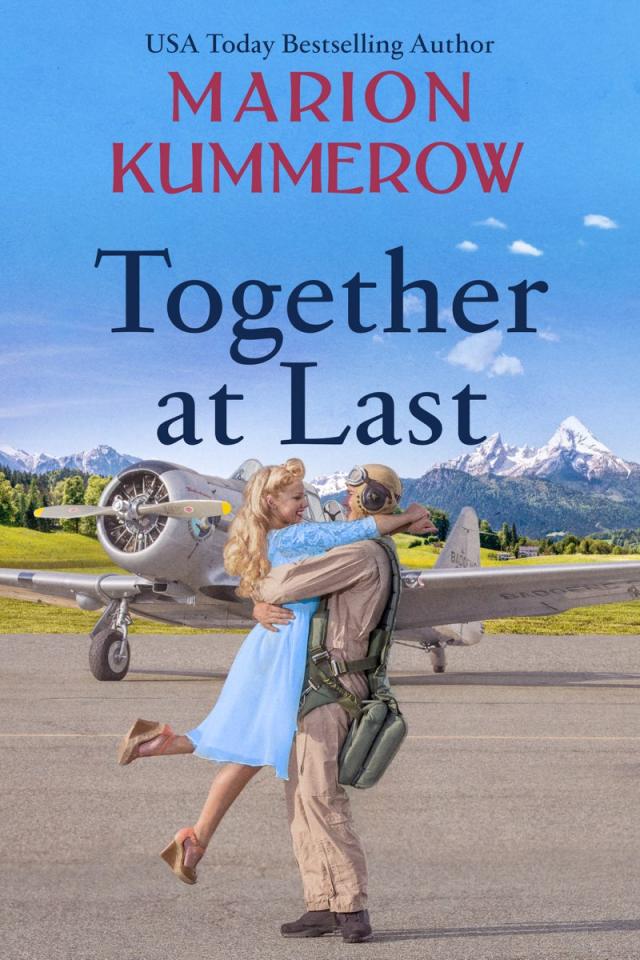


Together at Last
War Girl Series
Marion Kummerow
Together at Last, War Girl Series, Book 10
Marion Kummerow
ISBN Paperback 978-3-948865-07-8
* * *
All Rights Reserved
Copyright © 2019 Marion Kummerow
* * *
This book is copyrighted and protected by copyright laws.
No part of this publication may be reproduced or transmitted in any form or by any means, electronic, mechanical, photocopying, recording, or otherwise without prior written permission from the author.
This is a work of fiction. All characters, names, and places in this book exist only within the author’s imagination. Any resemblance to actual persons or locations is purely coincidental.
* * *
Cover Design by http://www.StunningBookCovers.com
Contents
Reader Group
Chapter 1: Ursula
Chapter 2: Tom
Chapter 3: Ursula
Chapter 4: Tom
Chapter 5: Anna
Chapter 6: Ursula
Chapter 7: Tom
Chapter 8: Ursula
Chapter 9: Richard
Chapter 10: Tom
Chapter 11: Anna
Chapter 12: Ursula
Chapter 13: Richard
Chapter 14: Tom
Chapter 15: Ursula
Chapter 16: Richard
Chapter 17: Tom
Chapter 18: Lotte
Chapter 19: Ursula
Chapter 20: Anna
Chapter 21: Tom
Chapter 22: Anna
Chapter 23: Lotte
Chapter 24: Ursula
Chapter 25: Tom
Chapter 26: Lotte
Chapter 27: Ursula
Chapter 28: Richard
Chapter 29: Tom
Chapter 30: Ursula
Chapter 31: Lotte
Chapter 32: Richard
Chapter 33: Lotte
Chapter 34: Ursula
Chapter 35: Tom
Chapter 36: Lotte
Chapter 37: Ursula
Chapter 38: Tom
Chapter 39: Ursula
Chapter 40: Tom
Chapter 41: Richard
Chapter 42: Ursula
Chapter 43: Anna
Chapter 44: Tom
Chapter 45: Richard
Chapter 46: Ursula
Chapter 47: Lotte
Chapter 48: Tom
Chapter 49: Ursula
Chapter 50: Tom
Epilogue
Author’s Notes
Also by Marion Kummerow
Contact Me
Reader Group
Marion’s Reader Group
* * *
Sign up for my reader group to receive exclusive background information and be the first one to know when a new book is released.
http://kummerow.info/subscribe
Chapter 1: Ursula
Kleindorf, Germany, April 1945
* * *
Ursula Hermann picked up Eveline, her one-year-old daughter, and carried her out to the front yard. The sun kissed her cheeks on this beautiful April morning. She decided to enjoy five minutes of idle time with her daughter before she walked over to bring lunch to Aunt Lydia and the farmhands.
She sat down on the swing with Eveline, pushing off with her foot to set the swing in motion. A sigh escaped her throat and Eveline turned her head to look at her mother. The child had inherited Ursula’s blonde hair, but the beautiful green eyes of her father, Tom.
“I’m so glad I have you, Evie,” Ursula said, pressing a kiss on her daughter’s hair. “You’re the one bright spot to come out of this war. You and meeting your father.” Thoughts of Tom seeped into her mind and the tormenting worry about him almost knocked her off the swing. She had last seen him before she even knew she was pregnant, had never heard from him again. Not since he’d set foot on the merchant vessel bringing him to neutral Sweden. She only hoped that he’d managed to return to his home in England.
“He’ll return after the war and find me. You’ll see, Evie. And then we’ll be a real family.”
Evie cooed as if she understood her mother’s words.
“We better bring Lydia and her helpers lunch. What do you think?” Being the only adult in the house all day, taking care of her daughter and her baby nieces Maria and Rosa, she missed conversation. Therefore, she had taken to talking to the children as if they were adults.
Ursula got up from the swing, tying Evie onto her back. She found Rosa, who was only six months older than Evie, still napping. Four-year-old Maria had climbed downstairs and was playing with a hand-me-down doll from her older sisters.
“Maria, come, we’re bringing lunch to your mom and your siblings,” Ursula said and picked up the heavy soup pot while she handed her niece spoons and bread to carry.
Together they walked the long, dusty road up to the field where Lydia was working. Her four oldest children and several women from Mindelheim, the town next to Aunt Lydia’s farm, helped her. The rural areas of Bavaria had escaped the air raids all the bigger German cities had endured. Giving the landscape a cursory glance, Ursula noted it seemed to look the same as always.
Only the schooled eye of a local would notice the fields that should be planted and already sprouting, but hadn’t even been tilled yet. There simply weren’t enough hands to accomplish the tasks that needed to be done each day, since all men between the ages of thirteen and sixty had been enlisted into the Volkssturm.
Ursula scoffed. The last resort of a national militia was made up of boys and ancients. How were they supposed to win the war? Her oldest nephew Jörg, the self-proclaimed man in the house, had avoided enlistment because he’d celebrated his twelfth birthday only last month. Not that the Party hadn’t tried to bribe, sweet-talk, and coax him into joining up. Thankfully, he’d taken his duties to run the farm too seriously to jump into such a reckless endeavor.
Herr Keller, the mayor, police chief and party official in Mindelheim was the driving force behind this. But Ursula doubted that he seriously believed in a successful outcome. How could young boys from the Hitlerjugend stave off the Allied soldiers when battle-hardened and experienced Wehrmacht soldiers couldn’t? What kind of delusional thinking was that?
The sound of marching boots reached her ear even before she saw a column of Wehrmacht soldiers dressed in feldgrau come up over the rise in the road. Ursula stepped off the road onto the field and called to Maria, “Come here. Get away from the street. There are soldiers coming.”
The Wehrmacht soldiers didn’t present a threat, but she thought it prudent to keep the small girl out of their way.
“Auntie, look. Why are these men so gray?” Maria pulled at Ursula’s skirt.
“Because their uniforms…” are gray, she wanted to say, but the words stuck in her throat as she saw the haggard, skeletal, exhausted and dejected-looking men. The picture of misery tugged at her heartstrings. About a hundred men, their ashen faces, hair and hands the same field gray as their uniforms, drudged past, eyes cast to the ground.
They didn’t carry heavy weapons, or have vehicles. Ragged handcarts were their only means to haul the limited supplies.
Ursula had seen many soldiers in the past five years, but never an entire column of such miserable figures. If this was what was left of Hitler’s army, then the war truly was lost already. And every passing day was simply delaying the inevitable: the complete collapse of the Reich.
One of the men, no older than her own twenty-four years, looked up and his eyes met hers. Even his eyes were gray. His entire being seemed nothing more than an accumulation of ashes. A human being who’d stopped living a long time ago and only his shell kept on marching. She recoiled from the way he epitomized what a miserable fiasco this war had become.
He broke from the line of marching men and mistaking her recoiling for fear said, “Don’t be afraid.”
“I’m not afraid,” she answered, a pang of guilt entering her heart. The poor man had been tasked with protecting his fatherland, protecting her, and she flinched at his appearance.
His gaze wandered down to Maria and the loaf of bread in her hand. Ursula saw his Adam’s apple dance as he swallowed.
“Can… may I have a bite?”
Tears sprung to her eyes at his simple request. Since when had the Wehrmacht stopped feeding her soldiers? She nodded, broke a piece from the bread and handed it to him, asking, “Where are you going?”
“Reinforce the Iller Line.” His voice made the rasping sounds of an ancient man.
The Iller River flowed from the Alps in the south all the way up to the city of Ulm in the north, where it emptied into the much bigger Danube River.
He seemed to read her thoughts. “We couldn’t hold the Danube Line,” he said, dejection transforming into embarrassment. “The Iller line is our very last chance to hold off the Americans.” Then he rejoined the marching column and left Ursula to her thoughts.
A small hand grabbed hers and Maria said, “See, Auntie? The man was gray. But why?”
Ursula stepped on the road again, not knowing how she could possibly answer the little girl’s question. His skin is gray because he’s dejected and hasn’t eaten or washed in a long time. Oh, and by the way, we lost the war, even though it’s not official yet. “We should hurry to bring your mommy the lunch,” she said instead.
Maria didn’t linger over the unanswered question for long and bounded a
A few days later, Ursula was tending to the vegetable garden when the mailman stopped at the house.
“Here’s something for you, Fräulein Ursula!” the old man on a rusty bicycle shouted out.
“For me?” She dashed to meet him and glanced at the brown envelope in his hand.
“From Berlin. I believe it’s from your mother.” In such a small place everyone knew everyone. Since Frau Klausen had often visited before the war and even lived here for a few months, the mailman knew her well.
Ursula grabbed it and eyed the handwriting on the envelope. It was her sister Anna’s. She narrowed her eyes, a horrible feeling of foreboding weighing her down. Anna rarely ever wrote letters. She was too busy working double shifts as a nurse at the famous Charité hospital and raising her stepson Jan on her own.
“It’s from my sister,” she said and almost giggled at the comical expression of disappointment on the mailman’s face. Since he made no move to leave she added, “I’ll go inside to read it. But I’ll make sure to let you know any important news from Berlin.”
In the kitchen, she took a knife and carefully opened the envelope. The date stamp read more than a month ago, but mail moved slowly these days, if at all, so getting a letter from Berlin was nothing short of a miracle. With bated breath she read her sister’s words.
* * *
Dearest Ursula,
I hope you and baby Eveline are doing well. I so want to see you both again and hold her. Let’s pray that we will soon be able to travel again.
You’re probably wondering why I am writing since Mutter usually does. But I wanted to let you know that Jan and I had to move back in with her. The building I was living in burned out and we had no place else to go.
But don’t worry, we are still in the highest spirits, confident that these sacrifices are nothing against the benefits waiting for us after the ultimate victory. We don’t grieve over a small material loss, but we celebrate the bravery we show.
Ursula broke out into loud laughter. How on earth did Anna come up with such hilarious lines? She could have simply said nothing, but mocking Hitler with his own words while satisfying the censors was brilliant.
Still, she didn’t really expect anything less than brilliance from her sister. Anna was the brightest of the four siblings. Once the war was over, she’d make her way as a truly exceptional researcher in the fields of biology and medicine. Ursula was sure of this.
Things here in Berlin are sometimes not ideal. But you shouldn’t believe everything you hear on the radio. We are well and happy… except for having to live with Mutter. I feel like I’m a child all over again. Mutter told me to give you her best regards. She’s looking forward to seeing you and her granddaughter again at the soonest possible opportunity.
But I have more exciting news for you. Remember the friend of mine who joined up to become a radio operator with the Wehrmacht?
That would be their little sister Lotte. She was living under the name of Alexandra Wagner and risking her life every day spying for the British while working as Wehrmachtshelferin.
Alexandra is well and in good spirits. She couldn’t give me details about her whereabouts, except that she is somewhere in Norway. It’s such a relief to have news of her.
Professor Scherer is wonderful as always and I’m grateful that I can work for such a renowned scientist like him. He has stopped all of his research and teaching and for the time being is dedicating his entire manpower to the war effort in helping our wounded soldiers.
I can’t tell you about the progress we’re making in the fields of bacteriology. It really is an interesting time we live in and I couldn’t be happier.
The only complaint I have is that we haven’t been able to see each other.
Give Aunt Lydia our love, hug the children, and kiss the baby for us.
Love,
Anna
Ursula shared the letter with her aunt and dreamed about the day when she and the rest of her family would finally be reunited. It couldn’t come soon enough for her.
Exactly two weeks later, on April 24th of 1945, American tanks rolled up the road and into Kleindorf. It was almost a non-event when it happened. No fanfare, excitement or even fighting accompanied their taking possession of the small farming village.
“For us, the war is over,” Aunt Lydia said to Ursula. “What will become of us now?”
“At least it’s not the Ivan coming to occupy us, but the Ami,” Ursula answered with a thoughtful glance at her nieces, the oldest one ten years old.
“We should hide inside,” Lydia said.
“No, we shouldn’t. They’ll check all the houses, so better we stay outside where they can see that we present no threat.” Ursula ran a hand through her blond hair. Unfortunately, the Nazi Party hadn’t given them a protocol on how to behave in case of surrender.
Jörg came running from the house with three white pillowcases and handed them out. “Here, take these!”
“What are you doing?” Lydia asked her son.
Ursula reached for the white linen, wondering when her nephew had grown up so much. Now, he actually filled the shoes of the man of the house and told the adults what to do.
“Making sure the Americans know no one here wants to fight,” Jörg answered.
“But, Herr Keller said…” Lydia began in a hushed voice.
“Herr Keller is a fanatic and a fool. Do you really want us to suffer the same fate as those living in Mindelheim?” Ursula couldn’t believe her aunt was still clinging to the orders the mayor had issued. Fight to the last man. Don’t surrender. We die rather than capitulate.
It would be laughable if it weren’t so sad. News had come from Mindelheim that a hundred boys aged ten to fifteen had launched into a hopeless fight against the American juggernaut. The catastrophic order to resist had come from Mayor Keller’s order, a staunch Nazi and a man for whom Ursula harbored a special sort of hate.
How could the mayor send boys armed with slingshots into combat against tanks and experienced soldiers carrying automatic rifles? According to one of the village women, forty-five of the boys had died in the senseless slaughter. The Americans had ordered to leave their corpses lying in the streets as a deterrent and example to others of what would happen if they didn’t surrender.
Mayor Keller, of course, had weathered the onslaught in the safety of the farm he’d stolen from the Epsteins years ago. Once the battle was over, he had then stoically greeted the Americans, pretending to be their friend. He had made sure they knew he was the man in charge of Mindelheim and the surroundings. Ursula wished someone had put a bullet in his head.
“Are you coming?” Jörg called out, shoving a pillowcase into his mother’s hand.
Ursula followed him, Lydia, and the children to the road, holding Evie in one arm. As soon as the first soldiers appeared walking up the path to the farmhouse, she waved the white pillow case with the other arm.
“Hello, ma’am, how many people live here?” one of them asked Lydia.
Lydia, who didn’t speak English, exchanged a helpless glance with Ursula. The younger woman felt incredibly grateful that after meeting Tom, she had started to learn English. Despite the Ami’s godawful accent, she had understood his question.
“Two adults and seven children,” she answered, her voice trembling with nerves.