Darkness beyond, p.1
Darkness Beyond, page 1


Contents
Cover
Also by Marjorie Eccles
Title Page
Copyright
Dedication
Part One
Prologue
Chapter One
Chapter Two
Chapter Three
Part Two
Chapter Four
Chapter Five
Chapter Six
Chapter Seven
Chapter Eight
Chapter Nine
Chapter Ten
Chapter Eleven
Chapter Twelve
Chapter Thirteen
Chapter Fourteen
Chapter Fifteen
Chapter Sixteen
Chapter Seventeen
Part Three
Chapter Eighteen
Chapter Nineteen
Chapter Twenty
Chapter Twenty-One
Chapter Twenty-Two
Chapter Twenty-Three
Epilogue
Also by Marjorie Eccles
The Herbert Reardon historical mysteries
BROKEN MUSIC
A DANGEROUS DECEIT *
HEIRS AND ASSIGNS *
THE PROPERTY OF LIES *
Novels
THE SHAPE OF SAND
SHADOWS AND LIES
LAST NOCTURNE
THE CUCKOO’S CHILD *
AFTER CLARE *
THE FIREBIRD’S FEATHER *
AGAINST THE LIGHT *
* available from Severn House
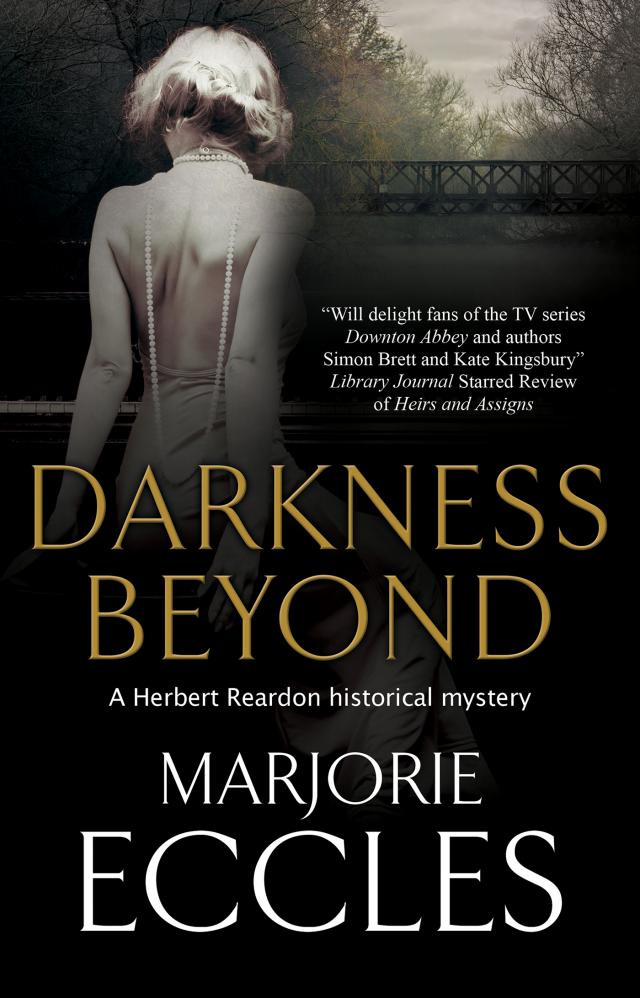
DARKNESS BEYOND
Marjorie Eccles
This ebook is copyright material and must not be copied, reproduced, transferred, distributed, leased, licensed or publicly performed or used in any way except as specifically permitted in writing by the publishers, as allowed under the terms and conditions under which it was purchased or as strictly permitted by applicable copyright law. Any unauthorised distribution or use of this text may be a direct infringement of the author’s and publisher’s rights and those responsible may be liable in law accordingly.
First world edition published in Great Britain and the USA in 2021
by Severn House, an imprint of Canongate Books Ltd,
14 High Street, Edinburgh EH1 1TE.
Trade paperback edition first published in Great Britain and the USA in 2022
by Severn House, an imprint of Canongate Books Ltd.
This eBook edition first published in 2021 by Severn House,
an imprint of Canongate Books Ltd.
severnhouse.com
Copyright © Marjorie Eccles, 2021
All rights reserved including the right of reproduction in whole or in part in any form. The right of Marjorie Eccles to be identified as the author of this work has been asserted in accordance with the Copyright, Designs & Patents Act 1988.
British Library Cataloguing-in-Publication Data
A CIP catalogue record for this title is available from the British Library.
ISBN-13: 978-0-7278-5060-7 (cased)
ISBN-13: 978-1-78029-787-3 (trade paper)
ISBN-13: 978-1-4483-0526-1 (e-book)
This is a work of fiction. Names, characters, places and incidents are either the product of the author’s imagination or are used fictitiously. Except where actual historical events and characters are being described for the storyline of this novel, all situations in this publication are fictitious and any resemblance to actual persons, living or dead, business establishments, events or locales is purely coincidental.
This eBook produced by
Palimpsest Book Production Limited,
Falkirk, Stirlingshire, Scotland
Rather more than kin, and less than kind
Hamlet
PART ONE
PROLOGUE
February, 1933
It was already dark as he headed through the town towards the other side of the river, to what now felt like hostile territory. Coat collar turned up against the rain, shoulders hunched, he moved fast under the pools of gaslight, past the darkened library, closed shops, the public baths, the fire station – familiar old landmarks, most of them, though some were new to him. It still wanted half an hour to opening time for the pubs, and the streets were all but deserted, except for one or two early customers drawn by the smell of the chip shop just beginning its evening frying.
He hadn’t expected nostalgia, still less sentiment, and impatience with himself for feeling either made him move even faster, each step taking him further into the dark that was yet to come. It scarcely mattered that it was on the edge of danger, what he was doing, where he was going. Damned if he did what he’d come back here to do, damned even more if he didn’t.
He crossed to the far side of the river bridge, sensing rather than hearing the pattering of the rain on the water below. Water under the bridge in more senses than one. Memories unravelling as the current bore with it recollections that were now only echoes, along with resentments that were not forgotten. He’d lived with both for too long to give up now, long before the Armistice fourteen years ago, which had brought peace for some, though not for him.
Since then – since 1918, and once the country’s lapsed building trade had received a restart kick – Ladyford Lane, where he now found himself, had become a prime location for the development of several large, expensive houses in extensive grounds. Folbury was a coming area now, conveniently not too far from the Black Country industrial hub, but still on the edge of real, open countryside, and a good proportion of these new homes had been purpose-built for Midland manufacturers, those with aspirations and money to spare: the war and its endless greed for munitions and everything else heavy industry could supply hadn’t been bad for everyone. And on the premise that if you’d paid that much for anything, it had to look as though you had, none of the new owners of these properties had lost the opportunity of showing off what they could afford. Mock Tudor facades everywhere, sweeping gravel drives, big landscaped gardens.
The one he sought had an unconventional white wall surrounding the property, an intimation of the surprise standing a hundred yards beyond the open black iron gates, at the end of a straight gravel drive. More of a shock than a surprise it must have been to the neighbouring property owners, landing there like some sort of alien space machine. His lips twisted at the name, Casa Nova, on the gatepost. Quasi-Bauhaus Modernist, an arrangement of cubes with some rounded corners, in dazzling white stucco with a shallow, startlingly blue-tiled roof. Astonishing to say the least in the British climate and unlikely in the extreme for Folbury. Still more so for at least one of its owners.
They were at home, or someone was. Light spilled from the windows as he crunched up the drive, ducked from the rain into the tiled porch and stood for a moment before raising his hand to the blue door. He didn’t bother with the bell. Trying the knob and finding it turned, he pushed the door open and walked straight into a spacious hallway lit by a skylight over the stairs, white-painted and furnished only with a sofa covered in zebra-skin, standing on a circular rug and flanked by two long wall-mirrors, bordered in peach and black glass. Screwed to the wall in the elbow of the broad flight of stairs sweeping up to an open landing either side, as if in a Hollywood musical, was the heavy old mahogany hood clock with its hanging weights, a deliberate, ironic fashion anachronism. And to the left, just three feet away, he was looking straight at the oil painting which had once graced Ernest Millar’s office, now prominently displayed here. No chance of anyone missing it when they entered the house. He was still staring at the face of his father, inimical as ever, when a door opened and into the hall walked his sister.
‘Thea.’
She stood rooted to the spot. One ghost on the wall and another standing in front of her. For several thumping heartbeats, Thea Millar thought she might be going to join them. All feeling left her. The shock of it froze her speech. Then, in a painful rush, one word came out. ‘Paul.’
ONE
It’s a relief to know that I am not, after all, about to die of shock after what I was faced with when he stepped into the hall – my brother, Paul, who has been dead for over fourteen years. I force myself to take a step towards him – and find I can go no further. We never were a family for embracing, no matter what, and now – especially now – to do so feels unnatural, impossible in fact, even in these circumstances. For where is the joy I should be feeling at seeing him, impossibly alive, here in the flesh? The charged, absurd hiatus goes on, in which anything I can think of saying seems so banal it might almost be laughable, in other circumstances: ‘You’re not dead, after all … Where have you been? … Why have you never written and let us know you were alive? … What happened to you, for heaven’s sake?’
And even more: ‘What in the name of God has made you come back now?’
It feels hard to breathe, let alone speak. Me, Thea Millar, too outspoken for my own good, and I’m tongue-tied. But Paul is not helping me and in the end I do find it possible to say something. ‘Your coat’s wet,’ is the most I can muster though, holding out my hand for it.
He shrugs the coat off and hands it over, and at last he says, ‘I’m sorry, I’ve given you a shock.’ As if that could describe the earthquake which has just rocked me to my foundations. I hang the wet coat up and move stiffly back into the sitting room I’ve just left, leaving him to follow, walking behind me with that very slight drag of his leg, almost imperceptible to anyone who didn’t know him. Waving him to a chair, I at last manage a further few words, as politely spoken as if to a visitor rather than my o
He sits. ‘Teddy not at home?’ he asks after a moment or two.
‘He’s getting ready to go out to a dinner. A Rotary do.’ I grasp the excuse and half-rise from my chair. ‘I’ll get him.’
‘Don’t disturb him. I can wait.’ Another silence. ‘You haven’t changed much, Thea,’ he says at last.
That’s an exaggeration, although my mirror tells me every morning that I don’t look my age. If there’s any truth in it, it certainly isn’t down to luck. My once waist-length hair is fair enough to have so far helped to camouflage signs of grey – but I’ve also gone along with the current fashion and had it bobbed, and I make sure my hairdresser keeps it nicely trimmed. I’ve always had a good skin and now I’ve learnt how to use a little discreet make-up, and though I’m by no means as slim as I’d like to be, I don’t over-eat and I suppose my figure’s still passable. He can’t know how many times I look in the mirror and there … Thea is not.
In her place there’s a woman I don’t recognize (and not only because I’ve had my hair cut), a woman whom most people would say has made an amazing success of her life, even to saving the family fortunes. Spinster of this parish, like so many other women of my generation, on the shelf, a leftover from the war. But settled, at ease with herself. How little they know!
‘You’ve worn well,’ he repeats, this time with the glimmer of a smile. I can’t say the same of him. Two years younger than I am, he looks not at all well, in the sense of what life has done to him. Seedy is the word that springs to mind. A cheap blue suit, his dark hair lank and a trifle too long. The pallor that was always natural to him now has a sallow tinge. He is still thin, dark and intense, with those high cheekbones and brooding eyes – a combination which always did give him that romantic, starving-poet image, while nothing could be further from the truth – the giveaway being the wry, slightly mocking twist to the mouth. All in all though, there’s still that dangerous-to-know suggestion which seems to be so attractive to some women. Less so than it used to be, though, I think, with something new about him I can’t yet put a name to.
Under the surface the questions I can’t ask – daren’t – are seething. I’m afraid of the answers, but I feel a sudden fierce rush of something like the protective love I used to have for him. Almost as much as I had for Teddy.
While I struggle with my feelings, the rain rattles on the windows, the gas fire hisses. He has given up attempts to start a conversation and sits back, taking in the room with fairly obvious incredulity, as well he might. He and I were always so close, close enough for me to predict what he was thinking, but it needs no special connection this time to read his reaction to what he’s seeing. It’s pretty much the same as everyone else’s. The room is thirty feet long, stretching almost the width of the house, light, airy and modern, panelled in maple wood. His quizzical glance takes in the dark, old-fashioned furniture salvaged from the old home, huge pieces at war with the rest of the up-to-date décor, in positions where Teddy would have placed blond wood, glass or chrome. His eyes fall to the faded Turkish rug that used to be in the old hall, the one he used to land on with a running jump from the stairs when he was a boy, so that it took him skidding along the length of the cold marble tiles; then his gaze travels to Mother’s rocking chair, still upholstered in its now balding green plush, and finally comes to rest on the massive old mahogany sideboard with its prim doyleys for ornaments, where its raft of photographs used to stand. Absurdity upon absurdity, in this up-to-the-minute, labour-saving, machine-for-living house that Teddy has designed – which to me is a nothing of a house, no more than a set of child’s building blocks put together, and just as uninteresting. Keeping the old family stuff was the only reason I agreed to live here at all, which was disagreeable of me, I suppose, since I was well aware of Teddy’s plans – he had expected to have furnished the house with things made yesterday. I am not in love, however, with modern furniture, or architecture either. When I think of the old house … but then, I hated that, too, didn’t I? Yet for reasons other than its ugliness: its cold, high rooms, the kitchen from another age, the echoing bathroom with its massive bathtub encased in mahogany, the blue and white flowered lavatory.
On the whole, perhaps it doesn’t matter: the design of the house itself makes what Teddy calls a statement, which is what he intended – it stands as its own advertisement for what he and Millar Homes can offer, and already certain people, those able to afford such, have shown interest in having it replicated for themselves. It serves its purpose for the two of us to live in.
Grandfather’s clock in the hall strikes the half-hour, echoed by the soft Westminster chime of his old glass-domed one that rests uneasily on the modern tiles of the fireplace mantelshelf. Six thirty. Have we really only been sitting here for less than five minutes? It seems like half an hour. But a situation that’s beginning to feel ever more desperate is saved when the door opens to admit Teddy, ready to go out for the evening in dinner jacket, dickey bow and a white silk scarf draped around his neck.
Paul jumps up immediately, both hands extended, while Teddy’s reaction mirrors my own. The colour blanches from his face and he stands stock still. They stare at one another. Paul may think I haven’t changed much, but that can’t be said of Teddy. Our youngest sibling is now a middle-aged man: affable, easy-going, with a face that is well-disposed to the world in general, a kindly-uncle exterior which, however, gives few clues to what had always promised to be a sharp mind. He has put on weight. He looks prosperous, the successful local businessman he is. The Millar genes have produced a certain family resemblance between me and Teddy which has somehow skipped Paul, but as Father once remarked of him – and in Teddy’s hearing, with one of his looks that said everything – ‘He’s Thea, yes … but without her compelling energy, unfortunately.’ Maybe remembering that was intentional and is what has spurred Teddy on. Father was adept at being deliberately cruel.
There’s no doubt he is just as shocked as I am, but his recovery is better. After the first disbelieving moments, his face breaks into an astonished smile, and he’s moving across the room. There is a moment of utter stillness when they meet in the middle. Then a huge, manly, back-slapping bear hug ensues. Unlike my own speechless response, Teddy’s now becomes vocal, if somewhat floundering. ‘Paul, good God, Paul, it is you – or am I dreaming? Tell me I’m not – and what the hell? How many years is it? You’ve a lot to explain, brother. But first – oh God, yes, you’ll have to excuse me, I have to – yes, I must make a telephone call. Thea, get Paul a drink while I make it. I won’t be two ticks, less than that.’
It takes a great deal to make Teddy forsake business commitments, but the Rotary dinner is apparently to be abandoned without a second thought. I make my escape by following him to the door, murmuring something about finding glasses, scotch and soda.
‘Cup of tea would be fine, Thea. I don’t drink now.’
Outside the door, Teddy’s eyes meet mine. Paul, not drinking? He spreads his hands, then crosses the hall and hurries up the stairs, while I go into the shiningly modern kitchen. All fitted cupboards and electrical gadgets, a washing machine and a huge monolith of a refrigerator that hums like an angry hornet all the time. Waiting for the kettle to boil, I remember the half-bottle left over from Ivy Pearson’s brandy butter for the Christmas pudding, and reach into a top cupboard for it. I take a large gulp straight from the bottle, probably unwisely, since I’m not used to spirits, but if Paul doesn’t need a bit of Dutch courage, I for one have never felt more need of it. It makes me cough, but it brings a sudden rush of warmth, and maybe a promise of easing the knot of pain that’s growing above my eyes. Like those other times, I can feel by the crawling on my scalp the beginnings of a storm, a darkness we are all moving towards, that no one can do anything to stop. I take another swig.
Having spun out the tea-making as long as I can, I take the tray back into the sitting room and occupy myself by pouring. I have just handed Paul a cup as Teddy comes back. He has divested himself of his evening clothes and has on a pair of flannel bags and a white cricket shirt under a sleeveless Fair Isle pullover. He looks more like the Teddy of old, the baby of the family, younger than Paul by ten years. He shakes his head at the offer of tea and goes to his pride-and-joy cocktail cabinet. It’s of golden maple and has a mirrored interior, pigeon holes and slots for the various implements and ingredients necessary for the serious business of cocktail making. Although he has his back to me I can see his hands are not quite steady as he pours himself a stiff measure. He turns, raising his glass. ‘Paul! My God, Paul! We thought you must be dead. Now, come on … Where the hell have you been?’