Bait, p.1
Bait, page 1


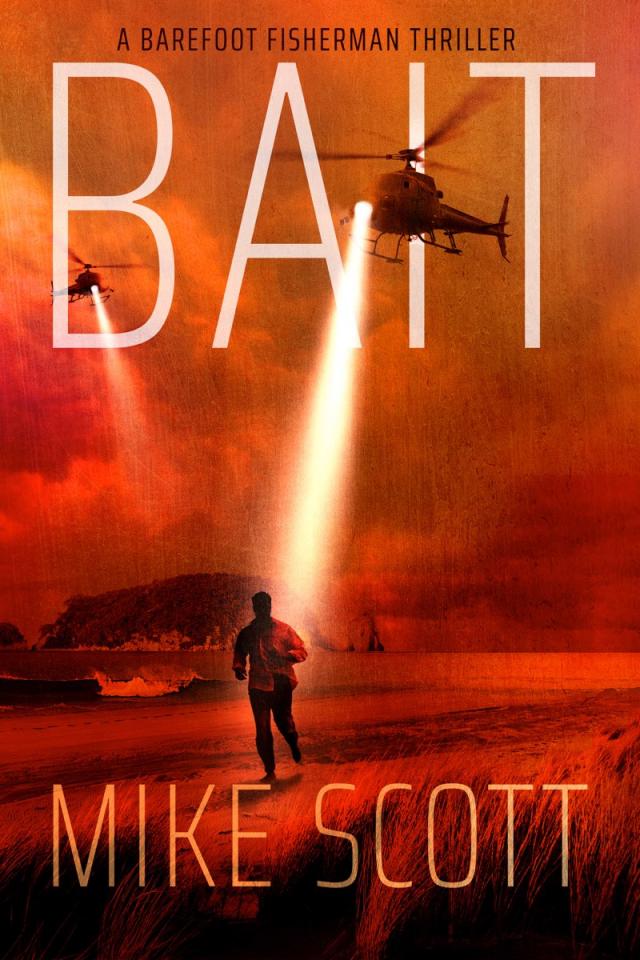
BAIT
Fisherman Achilles Smith lives off-grid on Great Barrier Island. A former elite soldier he has built a simple home by the sea and become part of a colourful community. Catching fish, growing food, and seeking nature’s healing to help him mend the scars of war. When he witnesses an assault in Auckland harbour, he rescues American journalist Barbara Walsh from certain death. Taking her to his home, he thinks the remote island off the New Zealand coast will keep her safe.
American billionaire sociopath Dominic King has a simple solution for man-made global warming: to destroy mankind. Desperate to silence Walsh, who he believes has uncovered his plans, King’s assassins find Achilles’ home and turn the peaceful island into a hunting ground.
With time running out will Achilles be able to save himself and the woman who has stolen his heart? What can he do to stop Dominic King’s apocalyptic plan before it is too late? Will becoming bait be enough to save the world from global catastrophe?
CONTENTS
Chapter 1
Chapter 2
Chapter 3
Chapter 4
Chapter 5
Chapter 6
Chapter 7
Chapter 8
Chapter 9
Chapter 10
Chapter 11
Chapter 12
About the Author
Copyright © 2023 Mike Scott
Mike Scott asserts his moral right to be identified as the author of this work.
All rights reserved. No part of this publication may be produced or transmitted in any form or by any means, electronic or mechanical, including photocopying, recording or information storage and retrieval systems, without permission in writing from the copyright holder.
Published by Seathrough Publishing
Email: seathrough.publishing@gmail.com
Author: facebook.com/mikescottauthor
This is a work of fiction. Names, characters, places and incidents either are the product of the author’s imagination or are used fictitiously and any resemblance to actual persons, living or dead, events or locales is entirely coincidental.
A catalogue record for this book is available from the National Library of New Zealand.
ISBN 978-0-473-67016-0 (Paperback)
ISBN 978-0-473-67017-7 (EPUB)
Cover design by Jeroen ten Berge, jeroentenberge.com
For Margot
ONE
A barefoot fisherman looked down at a sorry corner of the Pacific Ocean lapping an Auckland wharf. Achilles Smith was his name. He tapped the side of a refrigerated truck messaging the driver, who drove off into the night. He was not proud of this midnight rendezvous selling fish on the black market. The fish were prized yellowfin tuna he had caught, cleaned and iced at Great Barrier Island where he lived. If they caught him, they would confiscate his boat and send him to jail. Good on them, thought Achilles. He was not a dishonest man, and he would have rather obtained the money legally, but he needed money urgently for a friend. The law he had broken was taking fish without a quota and he had acted opportunistically after happening upon a school of feeding tuna. The wad of cash in his pocket was not for him but for a friend, Heremaia Walker, and his mother Riria, whom he credited with saving his life. Riria was dying from cancer, and he planned to give them the money so Riria’s daughter and grandchildren could fly back from Australia and go through quarantine in time to see Riria before she died.
Achilles and Heremaia had been soldiers together, inseparable buddies in the SAS in Afghanistan. The elite of the elite were confident and fearless until fate and the Taliban caught up with them in a well-planned ambush in a dusty Afghan village. A little girl in rags, a skinny street urchin who looked like she had never eaten a decent meal in her life, had walked out of an alley in front of Achilles. Her limbs looked ridiculously small compared to her torso, which was padded with explosives. She started to advance towards him, and he dropped his rifle so it hung on its sling around his neck and raised his hands and shook his head.
“Nachair, nachair, no, no,” he repeated, shaking his head and backing away from the girl.
He tried to make eye contact with her, but her expression of fear and hate showed no indication that she recognised him as anything but the alien invader he was. She kept advancing, pushing him back towards the men in the patrol behind him – the buddies he was tasked with keeping safe.
“Stop her,” they shouted as they dived for cover.
In desperation at the dilemma, he took his rifle and fired a round well over the girl’s head.
She stopped and a wide-eyed haunting look of utter betrayal scoured the life from her face, and Achilles knew she was going to detonate the bomb wrapped around her body. He was diving behind a low stone wall when the blast hit him, fracturing his skull.
He came to days later in a military hospital and the first thing he saw was Heremaia and to his horror saw that his buddy’s bandaged right leg was raised in a sling and had been amputated below the knee. The girl suicide bomber had been the signal for the start of a Taliban ambush in which Heremaia had lost his leg. Within two months both friends had been invalided out of the army. Heremaia returned to his family home on Great Barrier Island and coped with the change. Achilles, plagued by crushing headaches and recurring nightmares of the girl bomber and what he perceived as his failed response, sunk into a black pit of depression.
It was Heremaia inviting Achilles to stay with him at Great Barrier and placing him in the extraordinary care of his mother Riria that saved Achilles. Wisdom, strength and the unconditional love of aroha were the qualities she used to restore hauora – health and well-being –to the broken soldier. She set him to work, for he was a man of action, and like a racehorse he needed work.
The Walker homestead sits on a rise overlooking the mouth of Blind Bay on Great Barrier’s west coast. From the lounge window one looks down over the white wooden wharf at Okupu and across the Colville Channel to the tip of Coromandel Peninsula. On the flat below the house an old wooden fishing boat sits in a cradle surrounded by weathered cray pots and coils of rope. The only water that wets them now falls from the sky, and it saddened Riria that they would never again go to sea, for her husband, a fisherman, had died five years earlier.
Riria first put Achilles to work cutting firewood. Each day his output increased as his mind cleared with the physical exercise, and after a week he had cut, split and stacked two winters’ worth of dark oily manuka firewood.
Riria looked at Achilles’ great sinewed arms. He was like no man she had ever seen. She had trained as a nurse and Achilles reminded her of the anatomical drawings she had studied that showed the muscles beneath the skin. He showed so little subcutaneous fat anywhere on his body. Not on his face, his limbs or his torso did there appear to be anything but skin covering the pipe-like tendons and rippling bulging muscles attached to his tall, rangy skeleton. He was handsome enough with high cheekbones and a strong jaw but so lean, muscular and wild looking as to be intimidating and appeared to be at the point of divergence of a new hominid race. If it happened and he was the progenitor of a sub-branch of humanity, she had no doubt his descendants would be incapable of working in an office and would need a bony untamed island on which to thrive – Great Barrier Island or some such other untamed corner of the world, in other words.
When the firewood was cut Riria put him to work sanding and painting the dry, faded weatherboard house. By the second week she delighted when he started to smile and was pleasantly surprised to find, as he sweated away the depression, that his dry sense of humour returned. He was starting to heal working on the old house, stopping occasionally to watch gannets dive in the clear blue sea. In the evening he went down to the wharf and caught one or two snapper and watched squid hovering around the piles avoiding a ghostly John dory that floated past, waiting to ambush small fish. After a month he had given the whole house two coats of paint and Riria worried that she had begun to take advantage of him.
Sitting around the sparse dining table in the evening, Riria told Achilles it was time to move on and that she knew of land at Fantail Bay near Cape Barrier that was for sale. It was a wrench to leave the security of the Walker homestead, but Achilles knew the Walkers had done all they could to help him, and it was now up to him to help himself. He used his army severance pay to secure the bush-covered section that ran down to the water and had a stream, a big old plum tree and an old wooden hut that had been built by visiting beekeepers. Using his unbounded energy, he set about building a cottage by the plum tree and cleared tea tree to make a garden.
The demons that Riria had helped him face down and chase away came back to trouble him as he lived alone in the beekeepers’ shed. When he didn’t know what to do, he simply put on his army boots and headed off over the hills and around the bays, often ending up at Tryphena Wharf. Watching schools of small fish in the clear water under the wharf was a hypnotic distraction for him, and one day he was sitting on the wharf, head in his hands, when a stranger came up to him. Actually, Achilles was the stranger, not the man who had lived on the island for forty years. Achilles had seen him before, always barefoot and often accompanied by a black dog.
The man was much older, sixty-something and tough looking in his bare feet, shorts and T-shirt as though he was either going to or coming from a game of barefoot rugby.
“Ron’s the name,” he said, proffering his hand to Achilles.
“Achilles,” he replied.
“Where did you get those boots?” asked Ron. He had a slight drawl and a tendency to talk out of the side of his mouth.
&nb
“I know,” said Ron, for the story of the convalescing soldier at Fantail Bay was common knowledge in the small island community.
Ron looked at Achilles and at his boots.
“Have you got a problem with my boots?” asked Achilles. The older man was making him uncomfortable, but he was the only person Achilles had spoken to that day, so he fought the temptation to tell him to mind his own business.
“What do you need army boots for here?” queried Ron. “We’ve got no wars, no fighting and nowhere to march to.”
Achilles wasn’t sure what Ron’s uninvited point was or whether the man was subtly accusing him of something.
“You reckon I should take my boots off?” asked Achilles.
“If you’ve come here to leave the army behind, I reckon you’ll cover ground more quickly without those boots,” said Ron.
“What – are you a psychiatrist?” asked Achilles defensively.
“No, an archaeologist,” replied Ron. “I study the past, but I don’t dwell in it.”
Ron stared Achilles down. He reminded Achilles of his old school rugby captain: direct to the point of being offensive but on your side.
Achilles sensed he was at some sort of juncture in his life, and had to make a choice as he had when accepting help from Heremaia and Riria and buying his land at Fantail Bay. The choices he made determined which path his life would lead down. He could ignore this stranger’s advice or experiment with it.
He sat down, unlaced one boot then the other and threw them off the wharf into the sea where they sank without a trace.
“Reckon I won’t have to wash socks any more,” said Achilles.
“I reckon,” replied Ron with a grin and walked off, followed by his dog.
Achilles came to enjoy walking barefoot and those boots were the last shoes he ever owned. Whether walking on the shore in the cool of the water, stepping on sand or pebbles or seagrass or in the bush with soft leaf litter or damp humus between his toes, the soles of his feet slowed him to the island’s gentle hum. He grew stronger being in tune with the island and the scars in his mind healed over gradually. One morning months later he was waiting on Tryphena Wharf for the ferry to deliver materials for the cottage he was building at Fantail Bay. He looked down into the clear water and saw one of his old boots jammed among rocks on the breakwater. He was amused to see a small octopus had made the boot its home.
TWO
Achilles was certain no octopus could survive in the toxic ooze beneath the Auckland wharf where he now stood. His mission was complete and there was a spring in his step as he walked down the deserted wharf towards his launch, which would carry him sixty miles north across the Hauraki Gulf back to his island paradise. Wind was always a threat crossing the Gulf, but it was a perfectly still summer night. The city was asleep, with the only sound the occasional cry of gulls wheeling in the security lights on the wharf. He had nearly reached the end of the wharf when he heard a car behind him being driven at speed onto the wharf. Guilt twisted in his stomach and turned to fear as he turned and saw a police patrol car heading towards him. He jumped back into the shadows and hid, cursing himself for poaching fish and wondering how the police had discovered his crime.
The police car stopped twenty metres away and he was perplexed when no one got out. A minute ticked by agonisingly slowly then another, and as the occupants sat unmoving in the parked car Achilles realised they had not come looking for him.
The silence was finally broken by a multi-decked magnificent white launch speeding into view around the end of the wharf. The launch’s arrival was the signal for activity in the police car as the driver, a tall, thin plainclothes detective, got out, followed by a very large uniform officer from the back seat, where another passenger remained.
“Get her out,” said the detective.
“Move now, bitch,” ordered the tall, heavy uniform cop, bending down to speak to the passenger.
The person in the back seat did not budge.
“Get that bloody bitch out now,” barked the detective.
The big cop bent into the back seat, reached in and dragged a long-haired woman, who was bound and gagged, from the car with such force that she flew through the air and crashed with a sickening thump on the wharf.
Achilles was incredulous at what he was seeing. Shock mixed with déjà vu as he realised with dread that he was in a situation like facing the suicide bomber in Afghanistan. He had to act but his options were limited and the consequences dire. He could only conclude the cops were kidnapping the woman or worse. He couldn’t ring the police, as these men acting criminally were the police and he knew this wasn’t a situation where he could step in and reason with them. They had crossed a line where witnesses were likely to be eliminated.
He didn’t have the luxury of time to assess his options for the high-bridged launch was getting closer. He stepped out from the shadows and silently moved towards the cops who were facing away from him, focused on the rendezvous with the launch which had slowed and was gliding towards the wharf.
Barbara Walsh was the woman lying bound, gagged and winded on the wharf. The cops had kidnapped her from her home and on the drive to the wharf had openly discussed taking her far out to sea, tying weights to her and throwing her overboard. Her emotions had bounced between fear and anger and now she had reached a point of resignation. She had given up hope, when she saw the tall figure of a man emerge silently from the shadow and walk across the wharf towards her and the cops.
Meeting such a man at night in any other circumstances would have frightened her. The person she watched moved like a panther. He was wearing a T-shirt and jeans cut off above the calf and his extreme gladiator-like physique reminded her of the boxers she had seen when she had once gone on an unfortunate date to Madison Square Gardens in New York. The man’s face was set like granite, focused upon the back of the huge uniform cop who stood over her.
Suddenly the stranger looked down at her and gave her an encouraging smile and unclenched his right fist and gave her a thumbs-up signal. Like the moment when a light flicks on and off in a darkened house revealing its contents, the gesture hinted at an inner warmth to the mysterious stranger beneath his rough exterior.
Achilles was within striking distance of the uniform cop when the cop happened to glance back and see him.
The cop was a huge man about six foot six inches tall and one hundred and thirty kilos. He was much bigger than Achilles, who was six foot two inches tall and weighed about one hundred kilos. On the face of it, it was a mismatch, and the cop threw a massive roundhouse punch at Achilles’ head.
Barbara Walsh watched the fight unfold as if her life depended on it, which it did. What happened next astonished her, for Achilles blocked the cop’s punch and unleashed a barrage of blows to the cop’s body and head that felled him like an ox. Without pausing, Achilles caught the detective, who was in the process of drawing his pistol, and landed a powerful punch to his jaw. The detective was stunned, and Achilles grabbed him with one hand on the scruff of his neck and the other on his belt, marched him to the edge of the wharf and threw him off, so he plummeted spreadeagled, arms flailing down into the dark dirty harbour. The big cop started rising groggily to his feet and Achilles took hold of him and marched him across the wharf and threw him into the harbour with a loud splash.
Achilles used his pocketknife to cut the plastic cable ties binding Barbara Walsh’s hands painfully behind her back, then carefully removed the gag from her mouth. They could hear angry voices from the cops in the water and the men on the launch.
“Follow me,” said Achilles, helping her to her feet.
She followed him as he ran to the far side of the wharf. Looking down into the darkness, she could see a small old launch with a simple curved, white cabin roof and soft, gentle lines tied to the wharf. A daunting steel ladder disappeared over the side of the wharf leading all the way to the water and passing the stern of the launch on its descent.