Overreach, p.1
Overreach, page 1


Copyright
Mudlark
An imprint of HarperCollinsPublishers
1 London Bridge Street
London SE1 9GF
www.harpercollins.co.uk
HarperCollinsPublishers
Macken House, 39/40 Mayor Street Upper
Dublin 1, D01 C9W8, Ireland
First published by Mudlark 2022
FIRST EDITION
© Owen Matthews 2022
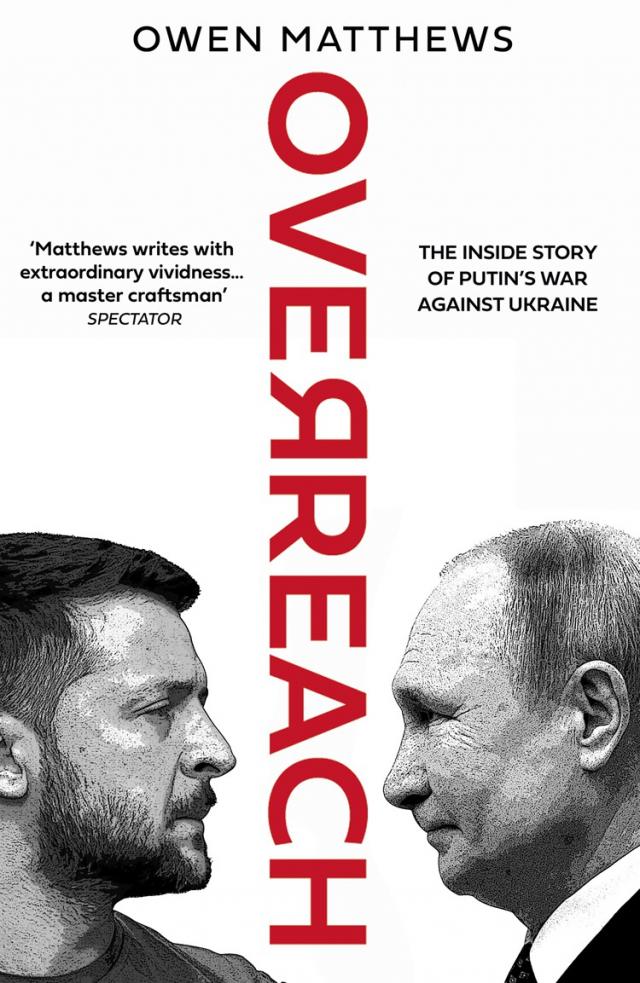
Cover design by Claire Ward © HarperCollinsPublishers Ltd 2022
Jacket photographs front: Reuters/Alamy Stock Photo (President Zelensky) and Mikhail Svetlov/Getty Images (President Putin)
A catalogue record of this book is available from the British Library
Owen Matthews asserts the moral right to be identified as the author of this work
All rights reserved under International and Pan-American Copyright Conventions. By payment of the required fees, you have been granted the nonexclusive, non-transferable right to access and read the text of this e-book on screen. No part of this text may be reproduced, transmitted, downloaded, decompiled, reverse engineered, or stored in or introduced into any information storage retrieval system, in any form or by any means, whether electronic or mechanical, now known or hereinafter invented, without the express written permission of HarperCollins e-books.
Find out about HarperCollins and the environment at
www.harpercollins.co.uk/green
Source ISBN: 9780008562748
Ebook Edition © November 2022 ISBN: 9780008562755
Version: 2022-10-10
Note to Readers
This ebook contains the following accessibility features which, if supported by your device, can be accessed via your ereader/accessibility settings:
Change of font size and line height
Change of background and font colours
Change of font
Change justification
Text to speech
Page numbers taken from the following print edition: ISBN 9780008562748
Dedication
For Ksenia, Nikita and Teddy
Epigraphs
For with pomp to meet him came,
Clothed in arms like blood and flame,
The hired murderers, who did sing
‘Thou art God, and Law, and King.
We have waited, weak and lone
For thy coming, Mighty One!
Our purses are empty, our swords are cold,
Give us glory, blood, and gold.’
Percy Bysshe Shelley, The Mask of Anarchy, 1819
What this country needs is a short, victorious war.
Prime Minister Vyacheslav von Plehve to Tsar Nicholas II, 1904
Contents
Cover
Title Page
Copyright
Note to Readers
Dedication
Epigraphs
Introduction
PROLOGUE: The Brink
PART I – BLOOD AND EMPIRE
CHAPTER 1: Poisoned Roots
CHAPTER 2: ‘And Moscow Is Silent’
CHAPTER 3: The Bleeding Idols
CHAPTER 4: Tomorrow Belongs to Me
PART II – WARPATH
CHAPTER 5: Warpath
CHAPTER 6: Truth or Bluff?
CHAPTER 7: Cry Havoc
PART III – PYROKINESIS
CHAPTER 8: Things Fall Apart
CHAPTER 9: Overreach
CHAPTER 10: Standoff
CHAPTER 11: The Price of Illusion
CHAPTER 12: Til Valhall
References
Acknowledgements
About the Publisher
Introduction
Everyone must understand: mobilisation is ahead and a global war for survival, for the destruction of all our enemies. War is our national ideology. And our only task, our leaders’ only task, is to explain to and convince all the Russian people that this our heroic future.
Russian writer and volunteer Donbas fighter Zakhar Prilepin, April 20141
‘You’d be happy to meet.’ My old friend Zhenia’s tone on the phone was flat and wary. It was 28 March 2022. The war in Ukraine had been under way for a month. ‘You want to meet just for the sake of happiness – or are you going to try to tell me why I’m wrong?’
‘Maybe you can tell me why I’m wrong? We can do that too. I’m in Moscow.’
There was a silence on the line.
‘Maybe some other time,’ he eventually replied. ‘It’s not a good idea for me to be seen with you right now.’
Once, Zhenia had been a rebel. At various stages of his career he’d worked as a labourer and a security guard, and served as an officer in the paramilitary OMON police and fought in Chechnya. He had edited the Nizhny Novgorod edition of the opposition Novaya Gazeta and had been a leading member of the revolutionary National Bolshevik Party. But by the time I met him at a literary festival in Saint-Malo, France, Zhenia had adopted a new pen-name – Zakhar Prilepin – and had become one of Russia’s greatest and most controversial novelists. Zhenia was shaven-headed, physically strong and had a generally threatening mien that had got him into a spot of bother with Saint-Malo’s CRS riot police. I helped him out of it. It was a bonding experience.
Zhenia – Zakhar – Prilepin was smart, well-read, unafraid. He was also passionate about his beliefs – which included a radical faith in the greatness of his country and a withering contempt for the venality of its current leadership. At a writers’ forum in the Kremlin in 2007 he’d sat across from Vladimir Putin and fearlessly taken the president to task for corruption and thievery. After the February 2014 annexation of Crimea, the Kremlin’s ideology had turned on its axis, and Putin and Zakhar found themselves in unexpected agreement: it was time for Russia to take up arms against her enemies. Soon after, Zakhar travelled to the rebel republics of Donbas in eastern Ukraine and became the deputy commander of a rebel battalion. In 2020, like his hero the radical writer and National Bolshevik Party founder Eduard Limonov, Zakhar founded a political party of his own. Its vision was of a manly, belligerent Russia whose destiny it was to purge the world of decadence through war.
Zakhar’s views may have been poisonous and insane and were undoubtedly dangerous. But they were sincerely held. And unlike many armchair patriots in the Russian elite who spent most of their time plundering the country they professed to love, Prilepin actually risked his skin for his beliefs. He was once my friend. Now, I suppose, he has become a kind of honest enemy.
I start this story with Zakhar for two reasons. One is that I am interested in what he will do next. Currently, the Kremlin is riding the tiger of Orthodox-fuelled ultra-nationalism that until relatively recently had lurked on the lunatic fringes of Russian politics. What will happen if Putin falters, either through military failure in the field or by losing his grip on the Russian elite or security services? If that were to occur, Zakhar’s vision of his country as a kind of new Sparta, implacable, militant and fired with holy righteousness, could be a terrifying glimpse into one of Russia’s possible futures.
The second reason I mention Zakhar is his refusal of my invitation to meet. I never found out his reasons. Perhaps he was nervous of being caught talking to someone who could be presented as a Western spy. Perhaps he thought I had become a Western spy. Perhaps he assumed that I was being tailed by the Federal Security Service, or FSB. Perhaps he thought he was. Perhaps he was afraid of hearing a different version of events from me that would shake his faith in his belief that Russian Orthodox warriors were battling Ukrainian Nazis (admittedly unlikely).
Whatever his reasons, Zakhar had clearly caught a dose of the pervasive paranoia of the times. It was a paranoia shared by the majority of my Moscow friends, colleagues and contacts. In the days following the beginning of the war it covered the city as quickly and obtrusively as the peat-fire smog that blankets Russia’s capital every summer. And like smoke, paranoia’s lingering smell was pervasive and impossible to avoid.
I have spent, on and off, 27 years reporting in Russia – first as a metro and features reporter for The Moscow Times and then as a correspondent and Moscow Bureau Chief for Newsweek magazine. In over a quarter of a century a total of perhaps half a dozen people refused to speak to me because I was a foreigner, or because they feared repercussions from the authorities.
That changed dramatically after the beginning of Russia’s invasion of Ukraine – or, more specifically, after the State Duma passed a law in early March making the ‘dissemination of false news about the Russian Military’ punishable with up to 15 years in prison. Soon afterwards the Duma also redefined an existing law on ‘foreign agents’ to include not just Russian individuals and organisations who actually received funding from abroad but also those who had come ‘under foreign influence’. Weekly lists of new ‘foreign agents’ were published and soon came to include almost every non-Kremlin-aligned journalist, broadcaster, blogger and analyst.
To my shock, when I began reporting this book in the first days of the war, friends and contacts whom I had known for years and decades told me that they could not risk meeting in public or speaking on the record. Even pro-Kremlin officials, both current and retired, as well as prominent patriotic media and political figures, grew cautious to the point of absurdity. Many sources refused to meet me in public places where they would be recognised speaking to a foreign reporter. And many of the most revealing co
Many of the sources cited in this book are, therefore, necessarily anonymous – in some cases to protect their identity, and in others because the remarks quoted were made in off-the-record social situations or in confidence. It’s frustrating, as a reader, to have to take anything on trust – and equally frustrating for a reporter to have to ask. But such was the atmosphere in which this book was reported, in Moscow and Kyiv, between March and September 2022. What surprised – and chilled – me most was how quickly Russian society shut down. Before Putin’s 2022 invasion there was a space in Russia’s political ecosystem for political opposition and for free speech. The space was narrow, but it was defined by a series of unspoken rules that were observed by the authorities more often than they were broken. Private anti-Kremlin opinions, even when spoken in public places or on social media, were never proscribed. Before 24 February 2022 stories of covering the telephone at home with a cushion were a quaint tale from Soviet days. After, many of my sources insisted that we sit metres away from our smartphones, or leave them behind when coming to a meeting.
Fear is infectious. Fear breeds especially fast in a world where long-recognised rules have collapsed and new ones not yet formed. Opposition activists and journalists once jokingly described the Putin regime as ‘vegetarian’ rather than carnivorous. With a few notable exceptions, it tended to intimidate rather than destroy. The Kremlin’s chief ideologue Vladislav Surkov – incidentally, a friend of Zakhar Prilepin’s and a relative of his by marriage – presided over a system based on an essentially postmodern, consumerist and ultimately cynical attitude to ideology. Some Orthodoxy here, a dash of Soviet nostalgia there – Surkov played chords of ideas like the keyboard of the organ of scents in J. K. Huysmans’ decadent literary classic À rebours. That relatively tolerant, vegetarian ecosystem collapsed after Surkov’s departure from the Kremlin in February 2020. It was replaced, as we will see, by the exclusive rule of paranoid ex-KGB men convinced that the West was on a mission to undermine and destroy Russia.
Anti-Putin people had always tended to be cavalier, even fatalistic, about their security. A few continued to be outspoken after the invasion of Ukraine on 24 February 2022 – but by that time insouciance had become an act of great bravery. What was more striking to me was how the pro-Putin people suddenly discovered fear. The ponyatiye – the set of unspoken ‘understandings’ that had ruled their world – was suddenly superseded by a new and unfamiliar gravitational field of patriotism and war. What was permitted in wartime Russia, what newly forbidden? Nobody knew. One former KGB major-general, a close personal friend and former university classmate of one of Putin’s most senior ministers, took me outside in midwinter to talk by a dacha’s woodshed where he could be sure we would not be overheard or seen. The daughter of a major oil magnate close to Putin asked twice to move tables at the White Rabbit restaurant because she didn’t like the look of people sitting nearby who might overhear us. And so on.
I mention these things not to give the impression that reporting in Moscow has become a cloak-and-dagger, le Carré affair, but to make the point that the political and media landscape of Russia changed very quickly and very profoundly in the aftermath of Putin’s invasion. Some old friends became aggressive, even obnoxious, patriots. Others realised that a Russia where one could pretend to live an open, prosperous European life no longer existed – or perhaps had only existed in their imaginations. Thousands of Russia’s best-educated people escaped into exile. But the vast majority remained and conformed – some actively, most silently. If the paranoia of war was like peat smoke, then the conformity was like snow, blanketing a whole society in a numbing blanket that deadened sound and feeling and sent people huddling for shelter. Some Russians found that shelter in the comforting tropes of their Soviet childhoods. Some found it in actively ignoring and blocking out reality. Until 21 September, six months into the war, life in Moscow continued as an almost aggressive simulacrum of total normality into which the war was not allowed to intrude. On that date Putin took the country – and his own elite – by surprise when he announced a partial mobilisation. Suddenly a war that had been all but invisible became, to tens of millions of Russians with male family members of military age, suddenly very up close and personal. From that moment on, no Russian was immune to the bitter political winter that had descended on their country.
The definition of a great conflict is that it results in the breaking of nations and a reordering of the world. By that measure, the Russo-Ukrainian War is the most serious geopolitical crisis in Europe since the Second World War, and one which will result in far greater global consequences than 9/11. The world’s security architecture, food and energy supply, balance of military power and alliances will be altered by it forever.
At best, Putin’s botched invasion of Ukraine could prove to be the last convulsion of expansive imperialism in European history and mark the final death of the age of empires in the West. It may also give China pause in its ambitions to use conventional military power against its neighbours. In the first weeks of the war Ukraine surprised both its enemies and its allies by demonstrating that overwhelming armoured and airborne force could be defeated by modern infantry-carried weapons, upending traditional Cold War era calculations of attack and defence. The world’s sanctions response to Russia’s invasion also showed that true economic power – including the power to devastate whole economies overnight – has shifted from nation-states to corporations, whose ethical and political decisions can carry more clout than those of governments. And Russia’s attempts to strike back by cutting gas supplies to Europe showed, surprisingly, that energy was in fact less potent a weapon than the West had once feared.
At the same time the Ukraine war made the world a far more dangerous place as Putin and his propagandists brought the idea of battlefield or even strategic use of nuclear weapons from the realm of the theoretical firmly into the realm of the possible. It also posed a fatal – and as yet unanswered – question about how much economic pain Western societies are willing to take in the name of defending the principles upon which their societies are founded.
The Ukraine war is the bloody final act of the collapse of the Soviet Union. Hostilities continue as I write, so the story is, therefore, necessarily incomplete. But though we have no idea of exactly how the conflict will end, we already know how it will not end. There will be no complete victory for either Russia or Ukraine. NATO is too invested to allow Kyiv to fall to the Russian army; Putin’s regime and his life are at stake if he allows Crimea, or for that matter the rebel republics of Donbas, to fall to the Ukrainians. He has said repeatedly that he is willing to defend that territory with nuclear strikes if necessary. Therefore this war will eventually end – as all wars that do not result in total victory end – with a negotiated peace.
Putin is likely to declare any final outcome a victory, and his control over Russia’s media is so complete that there is a good chance he will succeed in convincing many of his people to believe him.
But it’s also clear that however much formerly Ukrainian territory Putin manages to hang on to after the guns go silent, his attempt to reverse Ukraine’s westward drift and assert Russia’s new power and greatness has proved a catastrophic failure. Decades of careful economic planning have been destroyed, sympathetic allies all over the world alienated, hundreds of thousands of Russia’s brightest and best exiled, the country’s strategic independence profoundly compromised by a forced economic and political dependence on China. Putin has poisoned Russia’s future in the root. His self-declared victory will be one of the uneducated over the educated, of the provinces over the metropolis, of the old over the young, of the past over the future.
Putin’s invasion also precisely created the very things it was intended to avert. It united Ukraine and gave the country a true sense of nationhood. The war also reinvigorated NATO with new purpose, money and members, and also reminded the European Union of the post-war anti-totalitarian values on which European integration was first founded. On a more profound level, Putin reminded the democracies of the world that freedom does not just happen – the determinist conclusion that many in the West came to after the collapse of communism – but has to be fought for and defended.