Burn, p.1
Burn, page 1


Also by Peter Heller
Fiction
The Last Ranger
The Guide
The River
Celine
The Painter
The Dog Stars
Nonfiction
Kook: What Surfing Taught Me About Love, Life, and Catching the Perfect Wave
The Whale Warriors: The Battle at the Bottom of the World to Save the Planet’s Largest Mammals
Hell or High Water: Surviving Tibet’s Tsangpo River
Set Free in China: Sojourns on the Edge
THIS IS A BORZOI BOOK PUBLISHED BY ALFRED A. KNOPF
Copyright © 2024 by Peter Heller
All rights reserved. Published in the United States by Alfred A. Knopf, a division of Penguin Random House LLC, New York, and distributed in Canada by Penguin Random House Canada Limited, Toronto.
www.aaknopf.com
Knopf, Borzoi Books, and the colophon are registered trademarks of Penguin Random House LLC.
Library of Congress Cataloging-in-Publication Data
Names: Heller, Peter, [date] author.
Title: Burn : a novel / Peter Heller.
Description: First edition. | New York : Alfred A. Knopf, 2024.
Identifiers: LCCN 2023028064 | ISBN 9780593801628 (hardcover) | ISBN 9780593801635 (eBook)
Subjects: LCSH: Outdoor life—Maine—Fiction. | Friendship—Fiction. | Separatist movements—Fiction. | LCGFT: Thrillers (Fiction) | Novels.
Classification: LCC PS3608.E454 B87 2024 | DDC 813/.6—dc23/eng/20230626
LC record available at https://lccn.loc.gov/2023028064
Ebook ISBN 9780593801635
This is a work of fiction. Names, characters, places, and incidents either are the product of the author’s imagination or are used fictitiously. Any resemblance to actual persons, living or dead, events, or locales is entirely coincidental.
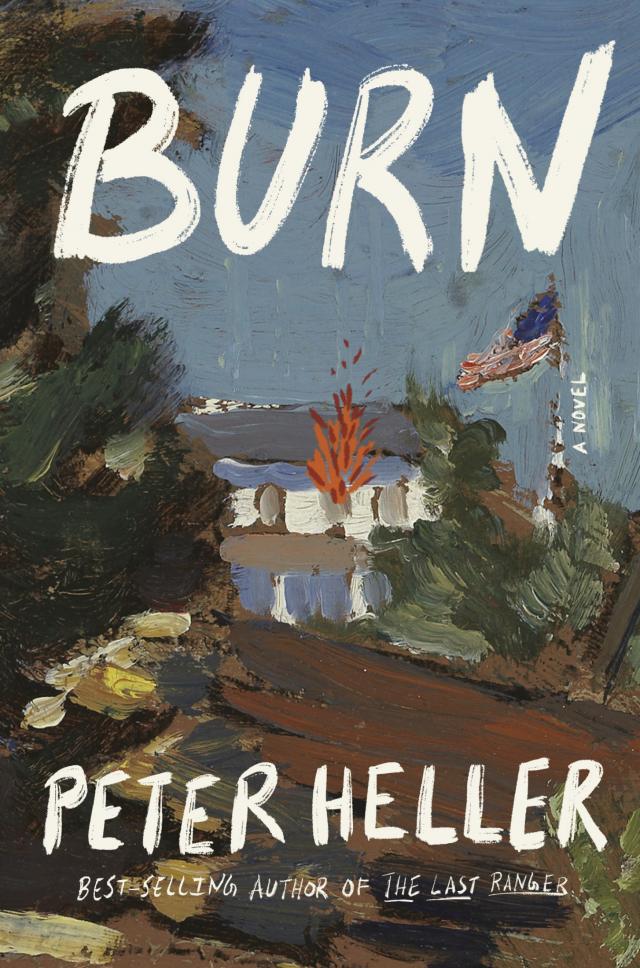
Cover image: Boat Building in Maine (detail) by Paul Dougherty. Photo © Brandywine River Museum of Art / Richard M. Scaife Bequest, 2015 / Bridgeman Images
Cover design by Kelly Blair
ep_prh_7.0_147841465_c0_r0
Contents
Dedication
Prologue
Chapter One
Chapter Two
Chapter Three
Chapter Four
Chapter Five
Chapter Six
Chapter Seven
Chapter Eight
Chapter Nine
Chapter Ten
Chapter Eleven
Chapter Twelve
Chapter Thirteen
Chapter Fourteen
Chapter Fifteen
Chapter Sixteen
Chapter Seventeen
Chapter Eighteen
Chapter Nineteen
Acknowledgments
A Note About the Author
_147841465_
To my grandmother Rose Backer Heller, and to my grandfather Harry Ashton Watkins. With all my love.
PROLOGUE
He let the fire burn down to embers, let the dark envelop him, and stood.
Jess stepped to the edge of the trees and looked down to the water. It was a big lake and he could see only the bay and the curve of the wooded shore and he could see that the water held there was nearly glass. The black mirror floated countless stars, and the stars barely rocked. He lifted his eyes to where they held fast in the depthless sky and he saw among them a satellite sailing swiftly east to west, and he wondered what it might be witnessing in its silent transit.
If he himself could be a night bird, like some great horned owl on soundless wings, would he fly north over the next town, over the road beyond it? Randall, that was the name on the map, wasn’t it? Would he want to see? Probably not.
In the days since they had found the bridge over the river blown and no way south he had dreamed hard every night. Dreams on dreams, with segues like swinging bridges. He had dreamed of their house, his house now, but it stood in the sage of some high western desert unprotected by a single tree, and the rail fences were broken, the horses vanished. In the dream they had more than one horse, but he couldn’t remember how many or if he had asked a neighbor to care for them while he was gone. Because he was gone. That was the gut weight of the dream, his own absence from anything like home. He dreamed the return again and again, a homecoming only as much as an old negative represented the photographed image, a homecoming that was as much a leaving, and she was never in it. He called for her inside a house he no longer recognized, and again and again in successive nights he walked around the house to the back, to the clothesline stanchions that gestured like empty crosses, and he found a well and he called for her there and dared to look down it and received only cold echo. He woke from that dream with the pillow of his rolled jacket wet. He lay in the wash of his own story and let the sound of a faint broken music trail off, and he let himself cry, and almost as soon as he gave himself permission to sleep he was pulled back into the dark. There was no swimming above it.
He dreamed then that he was in a pasture digging, first with a spade, which he laid down so he could scoop back the finely graveled mud with bare hands, the ditch some kind of drain, and when he stood he saw a former lover walking past the white clapboard house, her glance back seductive the way any vista is seductive just passing out of view. But he didn’t know her. He should but he didn’t. She had large dark eyes, as Jan had, and his longing was for something familiar, some beauty that rolled in his raw fingers as the prayer stone she had given him rolled now, while he stood with the trees at his back.
She called it a prayer stone. It was the size of a radish and taken from their favorite creek and given to him as a reminder to pay attention: Love is attention, she’d said. That is all you know on earth.
He had it in his pocket now, and as he stood at the edge of the woods and watched the drifting stars jostle barely on the water like faint semaphores, and smelled the cold sediment of the lake and the cold char of the town, he squeezed the stone in his right palm and wished he could signal her as the sparked reflections on the water seemed to blink to the thrown galaxies arching above: I am here. Forever rhyming, forever loyal.
Or maybe it was just an unheard music that time and space could never quiet. A music that turned and turned like a horse in the wheeling dark. And with that thought, and the warming stone chafing his palm, he thrummed with a grief and love so immense he could not contain it. To stand here. To breathe. To witness. He thought wildly in that moment, They better be enough.
Chapter One
They had come to the lake and the village that afternoon. They were on foot and it was the first real town they’d seen. Like the general store at Four Corners and the farm two miles north, it was burned to the ground. The houses, mostly wood, had left masonry hearths for monuments, and stone chimneys, and concrete slabs, and blackened stem walls. So close to the water, and the water table so high, few of the houses had basements; those were pits filling with water like abandoned quarries.
Of an entire town, only four dead, blackened bodies curled in the ruins. Where was everyone else?
They had moved up and down what once were streets, and they shouted, as if they might call them in like elk to a bugle. Nothing. Wind. The veering of the swallows who circled very high and silent and flashed violet-green when the sun broke through. Not much sun left: in scudding cloud, it was less than an hour off the ridge.
They came to the western edge of what once was a main street and stood against the dark woods. From there they could survey the mostly leveled ruin spilling downslope toward the lake. It was odd: Every vehicle they’d come across was a burned husk, but the docks of the marina still stood, and the boats tied there. A scattering of day sailer sloops rocked at their moorings. Rocked in an evening wind that brought the smells of lakewater and char. Jess had lifted the strapped binoculars to his eyes. Any living soul would be there in one of the boats, wouldn’t they? Crouched in some cockpit, huddled below in a V-berth as cramped as a coffin. They would be there with two days’ worth of canned food and a lake-full of water to drink, wondering if they were lucky or not to survive.
“What the hell,” Storey had said.
Jess shook in his fleece jacket as if he were cold. He lowered the binocs. “It’s like some war.”
“Jesus, Jess, it is a war.” Storey was ashen. He held his rifle unslung in his left hand and his cell phone in his right. “I can’t reach Lena. No reception. None.”
Jess knew. He had thought he might find some news on his phone, but there was nothing. They had had nothing for six days.
“I’ve gotta get home,” Storey said again, mostly to himself. It had become a mantra.
“Yeah, sure.” But neither knew how. South wasn’t working. Unless they walked and waded. It might come to that.
“We’ll hike up to Randall tomorrow. Right?” Jess said. “See if we can rent a car or something. Then maybe try heading straight west to Quebec. Then down.” They were in the middle of northern Maine. There were a few small towns and nothing else but lakes, woods, ridges, logging roads. It was maybe 75 miles west to Quebec as the crow flies, and much longer by gravel road. Straight to New Hampshire was about 150 miles southwest, but there was no way to go straight. The coast was just as far.
Storey stared hard at his oldest friend. “Rent a car,” he repeated.
“Maybe it’s local.” As soon as Jess said it he knew it was lame. Local. All summer the entire state had been convulsed with secession mania. It had pitted the populous coast against the sparse inland, the islands against the ports, islands against each other, Down East against Portland. County against county and town against town. And old Mainers against those From Away. What it really did, Jess thought, was stress any old fault lines and stir up simmering resentments. There had been calls for a vote in the state Legislature, a few riots, a shooting in Bath. But no one expected it to come to full-bore civil strife. They had discussed the risk while planning the trip and decided that what was happening in Maine was no worse than the stirrings of revolt in Idaho and the failed secession vote in Texas the year before. These were fringe minorities, vocal and passionate, but not a real threat. Also, they would be deep in the wilds of north-central Maine: the only time they’d see a soul was if they drove into some outpost convenience store for groceries and gas. And he’d needed this—Jess had. They’d been meeting for this hunt in the woods of different states for a dozen years now, and after the toughest year, Jess needed the return with his oldest friend to something known and worn and loved. To smells he knew, and ridges, and brooks; to the rhythms of camp and the hunt in which he could lose himself; to tradition.
So, this afternoon, as they stood above the burned town and surveyed the wreckage, they had not been able to countenance what they saw. Storey had rubbed his eyes with the back of the hand that held the phone. His cheek was wet. He shoved the phone into his pants pocket, shouldered the rifle, and sighted down to the lake.
“We need food,” he had said finally. It was true: at midday they had eaten the last of the freeze-dried dinners they’d packed for a week of hunting. “There’s gotta be some provisions on those boats.”
“Gotta be.” Jess lifted the binocs again and scanned the far shore of the bay. Where there must have been houses before, there were clearings, flagpoles, the pillars of other chimneys like gaudy headstones. “Camp here at the edge of the woods and go down tomorrow?” he had said.
“Okay. We should stay in cover. From now on.” Storey lowered the rifle. Lately, he liked to scan with the scope. One less step, in case. He looked at the lowering clouds. Probably coming rain. Among the swallows, below them, three nighthawks wheeled and fed. They were larger, just as agile, and they darted and swooped with a blinking of wing bars and a quiet muttering of staggered peeps. Someone was acting as if the world were normal, Storey thought.
They turned and walked into the trees.
* * *
Jess had gathered wood, the fallen limbs of spruce and white birch. He did not bother to muffle the sound as he broke the longer branches. They could see where the attack had swept out of the town—ash and mud and what must have been blood like oil stains on the county road that continued on north around the shore. How many, who knew. They were gone. A few warm embers in the ruin, and so probably just hours old.
He and Storey had a better map now, a water-stained gazetteer they had found fluttering outside the burned shell of a Bronco as they approached. No corpse, but the strewn contents of a rucksack littering down the two-lane highway—broken flashlight, a Gore-Tex rain jacket, packet of peppered jerky—as if the driver had been apprehended in flight. The Zippo Jess was using now had been lying in the road. Maybe they took them, survivors or bodies, took them all. The thought occurred to Jess as he crushed two handfuls of desiccated spruce twigs and lit them with the lighter. Why not the boats? It was as if they had had no time. Collect as many inhabitants as possible and move on. No time to row or swim out. But why not the boats along the dock? Bumping against their fenders, untouched? Maybe they had night vision, a thermal scope; maybe they could see no one was out there hiding. If they did have infrared, then camping back in the trees would offer little cover. Probably not. If they’d had night vision, he and Storey would be dead by now. Dead at thirty-seven.
The map showed the next town, Randall, nearly five miles up the lake. Ten-minute drive. Twenty. Given the state of the cooling wreckage and the seeming direction of travel, the attackers were there by now, there and gone. No column of smoke to the north, but that meant nothing. Jess shivered. If tomorrow the two of them decided to go that way, he had an idea of what they’d find.
Jess had set two palms on the duff either side of the scraped dirt and blew gently on the lit nest of twigs and watched the small yellow flame climb into the crumpled lace of dried spruce and find the small sticks above. He watched the flames adhere and propagate and run along the lengths of tinder and flutter orange to blue. He reached behind him and broke larger branches and laid them over and let the fire grow big enough to warm them. Storey could maybe read his mind: Jess heard his steps behind, and Storey said, “I’ll go down to the boats on the dock. No risk now.”
“Okay.”
“I’ve been cold in the summer bag, and someone will have sleeping bags or blankets. And maybe better dinner than mac and cheese.”
Jess said no word but nodded once; he did not turn and he heard Storey move off.
He had poured a two-quart water bottle into a pot and set it to straddle two rocks, and he took a stout stick and scraped embers and flaming wood between them. He built up the rest of the fire, and when he heard Storey’s steps behind him again he stood stiffly.
“Hey.” Storey’s voice ragged. “Hey—” The word cracked. Rustle as he set down two rolled nylon department-store sleeping bags. Jess turned. Storey’s face was strange, as in the face of a stranger. “I found someone. In the water.”
“Alive?”
Head shake.
“What?”
“I pulled her out of the shallows. She had a rock in her shirt. Tucked into the belly. Water maybe four feet deep.”
“So?”
“She could’ve shaken it loose anytime. She drowned herself.”
Jess blinked at his friend. “Maybe—maybe someone threw her in.”
“No.” That simple. When Storey knew something he knew it.
* * *
Jess had made the mac and cheese. There were two nested stainless-steel pots, and in the smaller he heated water, and he gave Storey a cup of Lipton with brown sugar. Some things had not changed much since their first outing, when they were kids. What had changed was the tempo of the music. They had both slowed, Jess more than Storey. It was less a physical ebbing—the expected scars and injuries and stiffness—less about bones and more about the heart. Jess thought that life’s mounting losses had slowed him. The loss of a wife the year before. The dog, Bell, he’d inherited from Jan. Jan Jan Jan. All gone into the dark.
They sat on a log Jess had dragged over and ate the noodles and two cans of Pringles and some chocolate bars Storey had found on the boats. A mouse had already sampled the chocolate, and they broke off the gnawed ends. There would be more food; they’d go down and look tomorrow.
They had strung up a tarp, as they had since their first hunting trip. They did not bother to build up the sides with brush for a windbreak because the breeze off the lake was light and with the extra bags as blankets they would be plenty warm. They let the fire burn down. Jess was the last one up and he did not bother to douse it.
* * *
They were woken by rain. Rain drumming the tarp, and rolling thunder, and flashes of distant lightning making brief calligraphy of the interlaced spruce boughs. The tarp was taut and big enough and they were dry.
Jess felt Storey bump against him as he shifted in his bag, and he murmured, “That is lightning, right?”
“Damn if I know,” Storey said. “That next town is five miles off and north. The flashes seem to be over the lake. Further off.”