

Swan light a novel, p.1
Swan Light: A Novel, page 1


PRAISE FOR SWAN LIGHT
“There is nothing not to love about Phoebe Rowe’s debut novel. Flawlessly researched and wholly immersive, Swan Light is a story about the importance of honoring the past. Rowe writes beautifully and takes readers on a journey to places both old and new, reminding us that sometimes the things we’re looking for are looking for us too.”
—Barbara Davis, bestselling author of The Keeper of Happy Endings
“Phoebe Rowe expertly interlaces the fascinating world of competitive shipwreck searching with a wonderful mystery about a vanished lighthouse. Two protagonists and two timelines can be tricky to pull off, but Rowe does so with aplomb in this excellent debut—I adored both the lighthouse keeper Silvestre Swan and the intrepid diver Mari Adams. I highly recommend this delightful novel.”
—Ann Napolitano, New York Times bestselling author of Dear Edward
“Phoebe Rowe’s descriptive writing in Swan Light transports readers to the harsh Newfoundland coast of the nineteenth century during the time when lighthouses rose from cliffs and harbours to both welcome and warn sailors. A story rooted in love and loss, the characters’ lives are woven together like a fishnet, drawing to the surface secrets that were buried beneath the waves for generations. Swan Light drew me in from the first stone dropped into the sea by the young Silvestre Swan and carried me through Mari Adams’s journey to unravel the mystery of the light and the people whose lives were intricately connected to its fate.”
—Jean E. Pendziwol, bestselling author of The Lightkeeper’s Daughters
“A wonderfully absorbing story that swept me away to Newfoundland and the mystery of a lost lighthouse and secrets hidden beneath the ocean. With a gentle narrative and rich atmosphere, Rowe creates subtle tension, keeping the reader guessing as the dual timelines and cast of characters tangle and entwine. Swan Light is an accomplished debut by a writer I look forward to reading much more from.”
—Hazel Gaynor, New York Times bestselling author of The Lighthouse Keeper’s Daughter
This is a work of fiction. Names, characters, organizations, places, events, and incidents are either products of the author’s imagination or are used fictitiously.
Text copyright © 2023 by Phoebe Rowe
All rights reserved.
No part of this book may be reproduced, or stored in a retrieval system, or transmitted in any form or by any means, electronic, mechanical, photocopying, recording, or otherwise, without express written permission of the publisher.
Published by Lake Union Publishing, Seattle
www.apub.com
Amazon, the Amazon logo, and Lake Union Publishing are trademarks of Amazon.com, Inc., or its affiliates.
ISBN-13: 9781662507434 (paperback)
ISBN-13: 9781662507441 (digital)
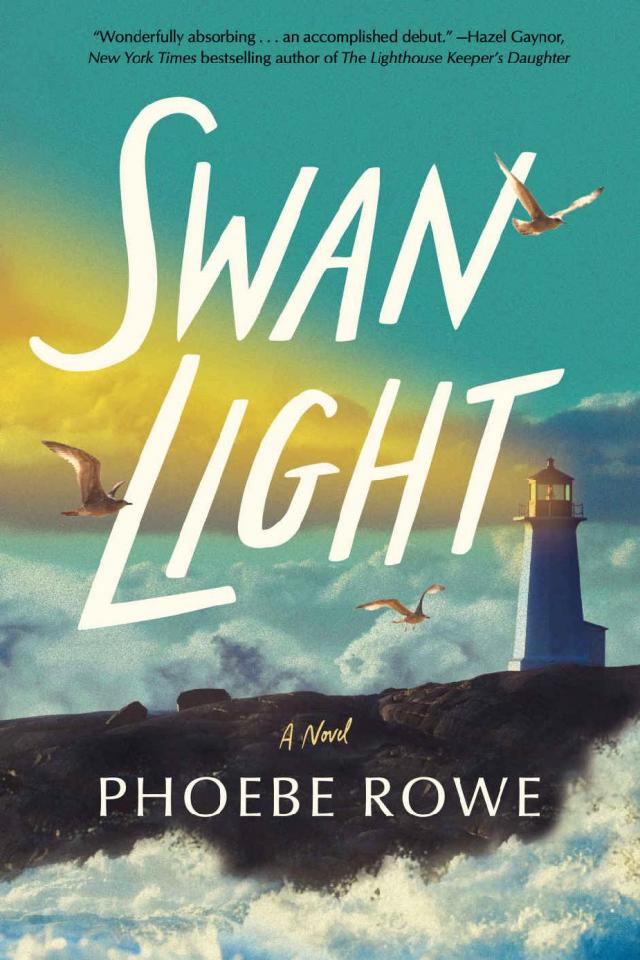
Cover design by Kimberly Glyder
Cover image: ©Ezra Bailey / Getty; ©shaunl / Getty
For Mom
My lighthouse
CONTENTS
Swan, 1913
Mari, 2014
Swan, 1913
Mari, 2014
Swan, 1913
Mari, 2014
Swan, 1913
Mari, 2014
Swan, 1913
Swan, 1913
Mari, 2014
Swan, 1913
Mari, 2014
Swan, 1913
Mari, 2014
Swan, 1913
Mari, 2014
Lou, 1913
Mari, 2014
Clara, 1913
Mari, 2014
Swan, 1913
Mari, 2014
Swan, 1913
Mari, 2014
Clara, 1913
Swan, 1913
Mari, 2014
Mari, 2014
Swan, 1913
Mari, 2014
Swan, 1913
Mari, 2014
Swan, 1913
Mari, 2014
Swan, 1913
Rose-Olive Cooper, 1913
Mari, 2014
Mari, 2014
ACKNOWLEDGMENTS
BOOK CLUB QUESTIONS
ABOUT THE AUTHOR
Swan, 1913
Silvestre Swan’s earliest memory was of losing something to the sea.
His mind filled in years later what must have come before that memory: another bitter spring morning restocking in St. John’s, wharves salt-slick and thrumming with creaks and shouts and splashes, harbor air heavy with the almond taste of ice. There was Tomas Swan, dark and wide, hauling netting through the street toward the water. There was Nico Swan, scrawny and fierce, scooping up the bits that dragged. And there was Silvy Swan, tiny, dawdling behind them both. He dragged his feet through puddles. He stopped to pet stray cats. He picked up cod-wet newspapers and poked them with his tongue. Somewhere in all of this, he must have found the stone. It was pale orange veined with gold, perfectly round, and he must have squatted in the mud to study it, unblinking and reverent, until—“Silvy! You want to swim home, then, yes?”—he ran to catch his father and brother.
But the memory itself came just afterward: an instant where he was pressed against Sea Split’s bow, holding the stone out over the whitecapped bay, breathless at its bright against the water’s black. It was so bright he was sure it would float. And so Silvy closed his fingers around his beautiful orange stone and he turned his hand upside down and he let it fall.
There wasn’t even a ripple. There was just the hiss of raindrops on the water and the crying of the gulls and the silence of the towering cliffs, Sea Split moving so quickly past them and into the harbor that he couldn’t tell where the stone had vanished. And hanging there empty-handed, Silvy didn’t have the words for what he’d done.
There were stronger memories of that same water later. There was its solid presence through the kitchen window of their leaky little house, his mother’s berry-stained hands soft on his own. There was its shape at the edges of summer days with Nico, making serpents out of seaweed and kingdoms out of coves. But now, as he looked out over the bay from the cliff high above, it was the orange stone that came back to him. It always did, on days like this one, in a particular kind of storm-ready gloom. Days when the wind was light and the birds were loud but the sea was a restless, hungry black.
Now Silvestre Swan stood with his hands on the iron rail of his lighthouse, watching the water and wondering how that little orange stone had slipped eighty years away.
The October sky was heavy, hiding a sun he hadn’t seen since Monday. In his logbook, during the darkest of it, he’d written STORM COMING IN. Yesterday he’d added a question mark. Today he’d decided to wait until later to dare to comment on the weather at all.
There was always a storm coming in here, the notorious St. John’s winters trickling their way down Newfoundland’s eastern coast to Norman Cliffs. But something felt different about this—a menace in the air that made Swan uneasy. He could feel it in the gulls, fidgeting in their roosts, and in the crash of waves far below his feet. To his right Highs Harbor was busy with day-fishermen eager to get out and back in, their masts cluttering the docks. The town of Norman Cliffs sat calmly on the hillside behind it, its bright clapboard houses smudged by smoke from their chimneys, gray shores dotted with dories and weathered wooden fishing stages. To his left the land was wilder, tumbling cliffs and wind-beaten brush stretching empty out of sight. Everything else was the sea, endless and churning, broken only once by the white foam of waves catching on the bar, the half-circle sprawl of shoal and sand and rock that ringed Norman Cliffs Bay like a hook. It hid below the surface, watching and waiting just like the rest of them.
Yes, there was a storm coming. But there was nothing to do about it until it hit.
That much, at least, never changed.
Swan turned from the ocean and stepped back into the warmth of the lantern room. He wiped down the door pane and the rest of the windows, dripping and icy now without the flame they guarded, hoisting himself onto creaking rails with his creaking knees to reach their tops. He cleaned the brass and each bull’s-eyed prism of the lens, his cloth turning black from the soot, and the iron base the lens stood on. He trimmed the wick and wiped splashes from the oil reservoir, and in the clockwork room on the floor below he cleaned the gears that kept the lens spinning, then cleaned his tools. He hummed as he went and the tower hummed along, thin notes coming from the white stone walls and the iron beams of the ceiling and the water-warped wood floor.
And then, when his stomach started growling and he could no longer put off leaving the tower, he turned his attention to the banker lurking in his wife’s hyacinths, peering in his side window.
In fairness, Cort Roland probably didn’t realize that the dirt he stood in was a garden. It had sat brown and flat beside the keeper’s house in the five years since Grace’s death, despite Swan’s occasional efforts. Once, the wild pink hyacinths had been everywhere, turning the cliff into a beacon of color, and had so inspired the town that they’d named Highs Harbor after them in homage to a feature they loved but couldn’t spell. Those flowers had died out decades ago, but Swan’s wife had resurrected a single patch, coaxing them back through the rocky soil. With her gone, the hyacinths were too, for good.
And in more fairness, Swan himself had invited the banker to his home. It had seemed like a good idea two days ago, when, fired with intention, he’d sent the dog into town with the invitation tucked under his collar. But faced with the prospect of actually speaking with Cort, Swan balked, and as he descended the tower stairs, he considered
“Mr. Swan,” Cort said, stepping away from the window without a shred of embarrassment and following as Swan trudged resignedly around his house to the front door. “Glad to see you up and about so early. I thought you might be having a lie-in in this wretched weather. Storm coming in, I’d think.”
“Yes,” Swan said to the second part, mildly offended at the first. He opened the door and stood back to let Cort Roland enter first, using the time to survey the rest of the cliff. Swan’s aging Labrador, Stay, was splayed in the center of the yard. Cort Roland’s horse, judging by the angle of the cart, had been forced to swerve around his unmoving form to enter the yard, and was now huffing and stomping far too close to the dog’s head. Stay did not seem at all concerned. “Stay!” Swan called, and the dog’s head came up with a soft boof. The dog had been Grace’s doing too. She’d named him the first time they saw him, a bedraggled stray chasing their cart home from town like an angry bear cub, fearless under the wheels. “Get out from there,” Swan had said, waving a hand at the dog, who had met his gaze and sat with a thump. “Stay,” he ordered.
But at his word the dog shot up and leapt after them. “He thinks it’s an invitation,” Grace said, laughing and pulling the reins. She climbed down and the dog put his head to the ground, bright eyes glued to her, tail wagging furiously. “Stay!” she said.
He galloped into her arms. The dog and the name both stuck.
Now Stay ambled inside and gave Cort a quiet huff before flopping down beside the kitchen table, his graying belly exposed. Swan stepped over him into the warmth of the two-room keeper’s house, the coals in the oven crackling merrily where he had lit them at dawn, the dark curtain that hid his bed ruffling in the sudden wind. Cort pulled the door closed behind him, rubbing his gloved hands together.
Swan took a deep breath. This had been a terrible idea. Best to get through it as quickly as possible. “Thank you for coming,” he said formally. “I asked you here in regards to the lighthouse. I’ve sent several letters to the bank, but I haven’t heard—”
But Cort was already waving one hand, reaching into his bag with the other. “No need, Swan, no need,” he said. “I’ve read your letters.” From the bag he produced a stack of paper—not the letters, something more formal, with the Norman Bank crest at the top—then another. Then a third. Swan thought wistfully of his breakfast tart, getting farther and farther away. But the yearning flickered out when he saw the paper at the top of Cort’s stack. The swath of dark ink, the flourish of a sure hand. Denied.
Swan let out a breath, and outside the tower grunted in an indignant echo. He raised his eyes to watch it through the kitchen window, its steady comfort of a presence, the way its glass-and-iron top reflected the sky behind it, the way its white stone glowed against the sea.
The sea that crawled closer year after year.
Once, it had taken minutes to walk from the tower to the edge of the cliff. Now Swan could cover the distance in half a step, the lighthouse tilting ever so slightly toward the waiting water.
He didn’t like to think about it. When he thought it too often or too loudly the tower overheard, and for days he wouldn’t hear the end of it in the wounded creaking of the stone and offended groaning of the walls. Who are you calling old, old man? The tower had moods as real as any person’s, could carry on a conversation if you knew how to listen for it. It was how Swan knew there was still time. The tower would warn him when the end was coming. And there didn’t have to be an end at all, not if the tower could be moved back from the cliff’s edge. It was expected, customary—lighthouses all along the Atlantic roped and lifted and rolled every few decades, tucked safely away from the water they watched over.
But until now Cort Roland, the wealthiest and most well-connected man in Norman Cliffs, the grandson of the town’s last living Norman, had given only his regrets. And now, this piece of paper. DENIED.
“Norman Bank is sympathetic to your trouble,” Cort Roland said, and Swan looked away from the cliff, back at the banker. Cort wasn’t looking at him, his blue eyes instead drifting appraisingly over the rest of the room. “Truly, we’d love to help. But I’m afraid we simply can’t justify the cost of relocating Swan Light.”
All of Swan’s carefully prepared arguments fluttered just out of his reach. “It’s less than a third of the cost of maintaining the harbor,” he said. “Surely it’s worth—”
“I’m sorry,” Cort said firmly. He still wouldn’t meet Swan’s eyes, his own now raking over the windowsill, where Swan kept the letters he’d saved from Grace. They still smelled to him like St. John’s mornings, her yellow desk below a rain-flecked window. He felt a flash of annoyance. As if he sensed it Cort turned, his gaze finally settling. “Like I said, it’s just too big an investment without getting anything in return.”
Your town’s safety in return, Swan wanted to say. A clear light to shore, a guide for every harbor-bound ship whose money and goods you’re so happy to take. But before he could speak any of it aloud, Cort continued. “However,” he said, his fingers drumming a light pattern on his paper, “I spoke with my grandmother about your situation. She was eager to help too, as you can imagine, given her own history with this lighthouse. And she had an interesting proposition.”
Outside the tower creaked again, deeper this time, a threat. Swan barely heard it, Cort’s sky-blue eyes transforming in that moment to his grandmother’s, bright and innocent against the rock of the cove. He could almost hear her voice, mocking: If you were ready to give them to Silvy, I thought you were done with them.
After all this time, what did Abigail Norman want with the lighthouse?
“What kind of proposition?” Swan asked, cautious.
“She told me about a deed she once gave your brother, Nico,” Cort said. “If it were rightfully returned to the bank, we’d consider funding the relocation of the lighthouse.”
Caution turned to anger at her nerve. She once gave your brother, Nico.
Abigail didn’t deserve anything from Nico now.
There had been five of them, once, on this same cliff, long before there was a lighthouse. Silvy, Nico, Sophie, Peter, Abigail. Lying on their backs in the grass, the sun dropping thick as honey behind the trees, Newfoundland salt all over their skin. In summers they watched the birds, the terns and murres and kittiwakes frolicking along the shore, and farther out the whales, their black rubber sides lithe and lazy. In spring they watched the icebergs, floes of white so vast they looked like ships of their own, moving slowly under sails of frozen water ages old. Blissfully unaware that they were heading for the doom of warmer waters.
He doubted Abigail remembered.
“So she’s holding the money ransom,” Swan said. “You won’t help me unless I give you this deed? I don’t have any of Nico’s things, Cort. My brother died almost seventy years ago.”
“Even so,” Cort said absently, his eyes now trained on the lighthouse behind Swan’s shoulder. Greedy blue eyes. His grandmother’s eyes. “Perhaps I could have a look around myself.”
But Swan had heard enough. Again he thought about those five children on the cliff, watching birds and whales and ice. They’d been taking care of Abigail Norman and her mistakes even then, even when they didn’t know it, even when they didn’t mind. None of them ever guessing that her greatest mistake would lead to the building of this lighthouse.
All he’d wanted out of today was his breakfast tart.
“I believe we’re done here, Mr. Roland,” he said quietly, standing and moving for the door so quickly that Stay yelped. “Thank you for your time, but I’m not interested. You should be getting on with your day now, before it gets too late. Like you said, there’s a storm coming in.”






