Marxism, p.1
Marxism, page 1


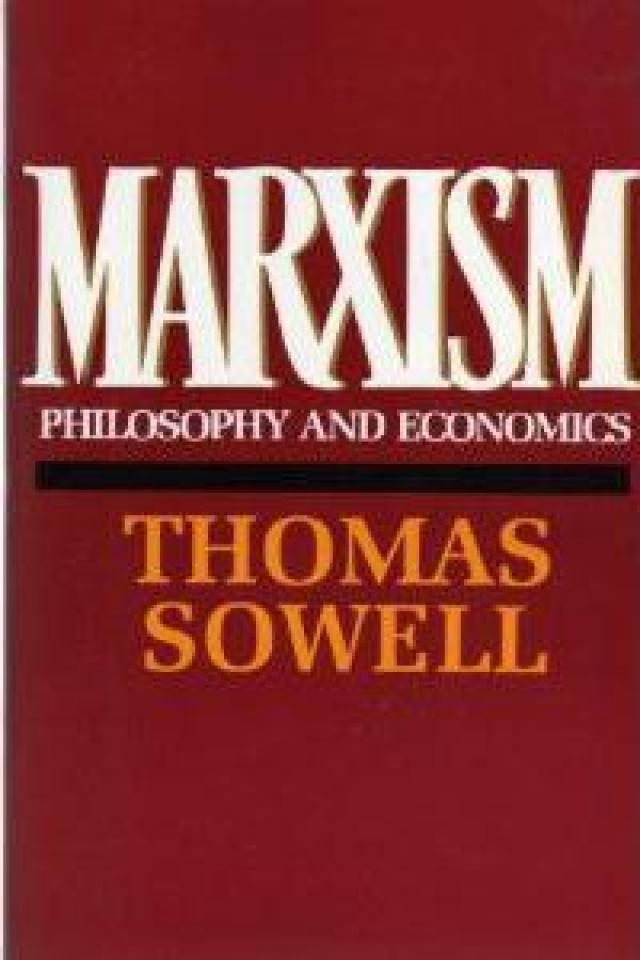
MARXISM
Philosophy and Economics
Thomas Sowell
Preface
This slim volume distills more than a quarter of a century of research and thought on the economic and philosophic doctrines of Karl Marx. Over this long span of time, it has been possible to separate the essential from the non-essential in the theories of Marx and Engels, and thus to say in a small book what would otherwise take several volumes. The most non-essential—indeed, intellectually counterproductive—aspect of Marxism has been the elaborate jargon and stylized rhetoric in which its substance has been discussed, especially by followers and interpreters. Marxists, non-Marxists, and anti-Marxists alike have become bogged down in turgid words, when the real subject is "the blaze of ideas," to use Marx's own phrase.[1]
Wherever possible, I have quoted the original words of Marx and Engels. But passage-quoting is not enough. For Marxian writings that fill many volumes and span several decades of changing circumstances and evolving doctrines, context is crucial. Interpretation is a demanding responsibility that cannot be discharged merely by stringing quotes together. However, it is not necessary to believe the doctrine that one can "prove anything" by lifting quotes from Marx. On the contrary. Much recent interpretive literature, especially in economics, inadvertently demonstrates that various interpretations of Marx cannot be supported by quotes from his writings. even articles in learned journals and scholarly books have solemnly and extensively analyzed particular "Marxian" doctrines without a single citation of anything ever written by Karl Marx. Often this "Marxism" bears no relationship to the work of Marx or Engels. In this way, particular doctrines and whole systems have emerged that might more accurately be called Samuelson-"Marxism" or Sweezy-"Marxism," etc. These modern concoctions have acquired a life of their own through sheer repetition, citation, and inertia.
While this book will not spend much space on refuting the secondary literature, there will be points at which the original Marxian analysis and doctrines will be contrasted with more recent fabrications bearing similar labels. Because the main purpose of this book is interpretation, its critical evaluation of Marxism will be saved until the last chapter.
A stylistic note may be in order. Because of Marx's penchant for italicized words, it should be noted here that all emphases are in the original, unless specifically stated otherwise.
My own philosophic, economic, and political orientations have ranged widely across the spectrum from the time of my undergraduate honors thesis on Marx at Harvard in 1958, through various articles on Marx in scholarly journals in the United States, Britain, and Canada during the 1960s, to the present work. What is gratifying is to be able to read back over these earlier efforts and see how little difference my own changing viewpoints have made in the purely interpretive analysis.
Compared to my earlier writings on Marx, the present book draws on additional knowledge, later scholarship by others, newly unearthed facts and more recently translated works—notably Marx's Grundrisse. But this has largely meant putting flesh and blood on a skeleton that has not changed essentially in form. What has become possible today is a more three-dimensional look at one of the most intellectually and morally challenging visions of the modern era, and one which this and succeeding generations will have to confront in one way or another.
Thomas Sowell
The Hoover Institution
September 3, 1982
Chapter 1 Economics and Philosophy
Philosophy and economics were not simply separate interests of Karl Marx. His philosophy provided the intellectual framework and the very language in which Marx discussed economics. That language must be understood in order to understand Marxian economics, regardless of whether or not the economic substance is logically independent. The philosophy is also important in itself as the driving force behind a vision that has come to dominate a major part of the globe and of the human species.
Marxian philosophy and economics derive from many sources, as well as bearing the unique imprint of Karl Marx and his lifelong friend and collaborator, Frederich Engels. The towering figure of G.W.F. Hegel stands out among the philosophers influencing Marx's thought, but other elements of his philosophy go as far back as Democritus, Epicurus and Lucretius in ancient times, Helvetius and Holbach in the eighteenth century, and Feuerbach among the contemporaries of the young Marx. In economics, the analysis and terminology of David Ricardo provide much of the background for Marx's Capital, but the intellectual predecessor of both men was Adam Smith, patron saint of laissez-faire capitalism.
A sharp distinction must be made between saying that the form of Marxian thought was shaped by some predecessor and saying that the substance was similar. The difference may be illustrated by comparing Hegel's description of a certain period of history with Marx's description, which was quite similar in form, but utterly different in content.
First Hegel:
These three events—the so-called Revival of Learning, the flourishing of the fine Arts and the discovery of America and of the passage to India by the Cape—may be compared with that blush of dawn, which after long storms first betokens the return of a bright and glorious day.[2]
Then Marx:
The discovery of gold and silver in America, the extirpation, enslavement and entombment in mines of the aboriginal population, the beginning of the conquest and looting of the East Indies, the turning of Africa into a warren for the commercial hunting of black-skins, signalized the rosy dawn of the era of capitalist production.[3]
Marx was quite open and frank in declaring himself "the pupil of that mighty thinker," Hegel, and deliberately used "the modes of expression particular to him," in writing Capital.[4] But he also sharply distinguished "the method of presentation" from the substantive inquiry.[5] To say that Hegelianism was the language in which Marx expressed many concepts is not to say that Marx's substantive statements repeat Hegel. It does say, however, that understanding the peculiar language and intellectual framework of a Hegel or a Ricardo is necessary for understanding the economics of Marx. As the distinguished economist J.A. Schumpeter once observed: "This is all the more important because the necessity for it does not show on the surface." That is, words like "alienation" or "contradiction" (from Hegel) or "wages" and "value" (from Ricardo) can be taken in their ordinary senses and Marx interpreted coherently—but incorrectly, and completely missing the point of his arguments. Marx's business cycle theory, for example, has been grossly misunderstood by interpreters who have seized upon the word "contradiction" in its ordinary (non-Hegelian) sense. Marx's predictions about wage levels under capitalism have likewise been greatly distorted by interpreters unfamiliar with the peculiar Ricardian concepts of "rises" and "falls" in wages.
Marxism is not inherently difficult to understand, in either its philosophic or economic aspects. It has, however, been made difficult by a number of circumstances. One was Marx's method of presentation, especially in his massive classic, Capital. Other sources of difficulty are the numerous and diverse interpretations by writers who ahve no troubled themselves to study the philosophic and economic framework of Marx's ideas. Schumpeter listed a formidable set of prerequisites for studying Marx[6]—and these can also be read as a list of reasons why so few interpreters have understood Marxism. Much of the modern economic literature, for example, sidesteps the whole problem of interpretation by taking what is commonly believed about Marxian economics as a starting point, and then elaborately analyzes and critiques the implications of these "Marxian" doctrines—often without a single reference to anything actually written by Karl Marx.[7]
Another source of interpretive difficulty is that the classic writings of Marx and Engels were polemics written against competing doctrines. Many of these competing doctrines were prominent at one time but have now disappeared into obscurity, so that later interpreters have not fully understood what it was that Marx and Engels were arguing against—and therefore have not always understood the real thrust and limits of their words.
In addition to its own peculiar problems of interpretation, Marxism shares a common danger in the history of ideas—the tendency to interpret earlier writers by reading back into them later ideas and events. Thus Keynes' ideas have been read back into Malthus, and fascism into Pareto. To avoid this fatal trap, Marx's communism (with a small c) will be distinguished from twentieth-century Communism as the doctrine of a particular set of parties or governments. The degree of correspondence between the two is an empirical question to be investigated at the end of the analysis, not a foregone conclusion to be assumed at the outset.
Finally, there are claims made by some scholars that Engels did not really understand Marx's ideas, and that much that is taken as authentic Marxism is Engels' writings is incorrect or misleading.[8] This would be unfortunate, if true, for Engels' writings are often much clearer than Marx's and a valuable source of clarification would be lost. Nevertheless, this claim will be examined in later specific discussions. For now, it may suffice to point out that Engels and Marx collaborated for four decades, exchanged letters with great regularity,[9] and each wrote part (or all) of some writings that appeared under the other's name,[10] in addition to their explicit co-authorship of many writings. It is no small task to intellectually separate Marx from Engels, nor has this task been seriously undertaken by those who depict Engels—an intelligent and well-read man—as misunderstanding a friend whose ideas he was more familiar with than anyone else in the world.
In short, there are difficulties of interpretation due to the original sources, the intellectu
The approach here will be neither an uncritical exposition of Marxism nor a continuous sniping at the Marxian ideas in the process of explaining them. Rather, the exposition and the critique will take place in separate chapters.
Chapter 2 The Dialectical Approach
Out of the massive and complex writings of the philosopher G.W.F. Hegel, and the derivative writings of the neo-Hegelians who flourished in Germany during Marx's youth, certain key concepts of Marxism developed. Then and now, these concepts have produced an arcane language of their own,[11] less an expression than of an obfuscation of the underlying ideas. "Dialectical materialism" is perhaps the most comprehensive of these arcane terms—though not a term used by either Marx or Engels. It is a general label for Marxian philosophy, expressing the simple fact that Marxism uses the approach called "dialectics" by Hegel and is also in the centuries-old philosophic tradition known as materialism. These two aspects can be examined separately and then their interactions seen in the Marxian theory of history in general, and of capitalism in particular. This will be done in Chapters 2-4.
Dialectics
Marx and Engels emphasized the dialectical method of Hegel[12]—the way he looked at and analyzed the world—rather than the elaborate philosophic system erected in his books or the "mystifying"[13] language in which he expressed it. What Marxian philosophy derived from Hegel was that the way to understand the world was not to see it as a collection of things but as an evolving process. An acorn or a caterpillar could not be understood as a fixed and isolated thing, without seeing that it was a transitory stage of an ongoing process that would eventually turn one into an oak tree and the other into a butterfly. Social analogies to metamorphoses in nature abound in the writings of Marx and Engels.[14]
Dialectics in Plato referred to the counterpoints of an argument. Dialectics in Marx referred to opposing forces in reality—internal and inherent forces whose mutual conflicts produce metamorphoses. It is not the shaping of clay by an external force for an external purpose, but the unfolding of internal forces—each intrinsic to the thing itself—that transforms it into some other thing, predetermined by what went before. Acorns do not become butterflies nor caterpillars become oak trees. Each unfolds according to its own inner pattern. Understanding that pattern is understanding the essence of the thing itself. Seeing only a particular phase of it as it is exists empirically at a given moment is being deceived by appearances.
The distinction between the inner essence and the outward appearance is one which runs throughout Marxian philosophy and Marxian economics.[15] An "appearance" is not simply a delusion without foundation. It is quite real, however incomplete and therefore misleading. The blind men who felt different parts of an elephant were not simply imagining what they felt, but were nevertheless quite mistaken in their inferences about the nature of an elephant. A distorting mirror produces an appearance quite different from the reality, but wholly based upon the reality and systematically related to the reality. A given stage of metamorphosis is quite real, but an acorn, a caterpillar, a tadpole, or an apple blossom may be a completely inadequate and misleading representation of what will ultimately develop.
The dialectical approach rejects uncritical acceptance of existence empirical appearances, and seeks instead the inner pattern from which these appearances derive and evolve. There are both methodological and ethical consequences to this approach.
Methodology
If one wishes to understand the essence, and all that is visible is the appearance, then one must abstract from what is visible, analyze the abstraction, and then reason systematically from there in order to get back to a truer understanding of empirical reality. Although, superficially, common sense might suggest that one "commence with the real and concrete," yet "on closer consideration," according to Marx, this approach "proves to be wrong."[16] What is "the scientifically correct method" is to proceed by simplifying the concrete into an abstraction—an "imaginary concrete" which becomes "less and less complex," until "we get at the simplest conception." Then, by systematically adding complicating factors, we "start on our return journey" toward empirical reality, "but this time not as a chaotic notion of an integral whole, but as a rich aggregate of many conceptions and relations."[17]
In short, Marx was a believer in abstraction, systematic analysis, and successive approximations to a reality too complex to grasp directly. It was precisely the complexity and ever-changing phenomena of the real world that made systematic analytical procedures—science—necessary. As Marx expressed it: "All science would be superfluous if the appearance, the form, and the nature of things were wholly identical."[18] The same point was made both in Marx's correspondence and in the third volume of Capital.[19] Marx based his approach on the Hegelian "method of advancing from the abstract to the concrete," while disapproving the way Hegel presented it.[20] Abstract deductive analysis is necessary because "every-day experience," according to Marx, "catches only the delusive appearance of things."[21]
Marx's economic analysis, especially in Capital—was constructed in this pattern of systematic, successive approximations. In the preface to the first volume of Capital, Marx asserted:
In the analysis of economic forms... neither microscopes nor chemical reagents are of use. The force of abstraction must replace both.[22]
In the first volume of Capital, Marx also referred to various puzzling economic phenomena which could not be dealt with at the level of abstraction there, under the many simplifying assumptions of that volume, but which would be explained later in the third volume,[23] where many of these assumptions were eliminated. This echoed the approach in his earlier book, Critique of Political Economy, where at the beginning Marx warned that there would be no "anticipation of results" which depended on later stages of the argument.[24] Conversely, at the beginning of the third volume of Capital, after all the preparatory analysis that went before, Marx said that the phenomena to be discussed would now "approach step by step that form which they assume of the surface of society, in their mutual interactions, in competition, and in the ordinary consciousness of the human agencies in this process."[25] The analysis had advanced from the inner essence to the outward appearance.
Marx's methodological criticism of the classical economists underscored the importance he attached to successive approximations—and to consistently operating under one level of abstraction at a time. Of Adam Smith he said:
On the one hand, he traces the inner connection between the economic categories—or the hidden structure of the bourgeois system. On the other hand, alongside this inner connection he sets up also the connection as it is manifested in the phenomena of competition, and therefore as it presents itself to the unscientific observer as well as to the man who is preoccupied and interested from a practical standpoint in the process of bourgeois production. These two modes of approach in Adam Smith's work not only run unconstrainedly side by side, but are interwoven and continuously contradict each other: the one penetrating to the inner relations, the physiology as it were, of the bourgeois system; the other only describing, cataloguing, expounding and bringing under classifying definitions the external phenomena of the process of everyday life in their outward manifestation and appearance.[26]
Even the more analytically rigorous David Ricardo did not escape similar criticisms from Marx. For "while Ricardo is accused of being too abstract, the opposite accusation would be more justified—i.e., lack of the power to abstract," to stay on one level of abstraction without bringing in factors belonging on a different level.[27] For example, Marx considered it a "mistake" on Ricardo's part to have discussed the modifications of his value theory before reaching the stage of the argument where the modifying factors had been analyzed.[28]